Right-of-way acquisition is rarely simple. According to a GAO review of federal highway development, purchasing right-of-way after negotiations begin generally takes 1-2 years, and final design plus acquisition for a major project often runs 2-3 years. Energy and pipeline projects face similar exposure when the underlying easement isn't properly documented.
This article breaks down the distinct modes of easement acquisition, how they differ, and how professionals determine which one applies before a project reaches final design.
Key Takeaways
- Easements arise through five distinct legal modes, each with unique proof requirements
- Express grant via a written, recorded agreement offers the strongest, transferable rights
- Necessity, prescription, implication, and condemnation arise from circumstances alone
- Confirming the correct mode early prevents title disputes and construction delays
- Landman due diligence helps energy companies secure enforceable easements before design finalizes
What Is an Easement and Why Does the Mode of Acquisition Matter?
An easement is a non-possessory right to use someone else's land, called the servient estate, for a specific purpose. The party benefiting from that right holds what's known as the dominant estate. Common examples include:
- Pipeline and utility right-of-way corridors
- Roadway and driveway access
- Drainage and stormwater paths
- Mineral transport and gathering line corridors
The mode of acquisition determines whether that right actually holds up. How an easement was created shapes its scope, duration, transferability, and whether a court will enforce it years later.
When the Mode Is Unclear
Problems surface fast when nobody can point to how an easement was established. A 50-state study on right-of-way acquisition found condemnation rates ranging from just 0.56% in Colorado to nearly 50% in Rhode Island. Roughly 80% of acquisitions nationwide get resolved through negotiation instead.
That wide variation reflects how differently states treat access disputes when documentation is missing or contested.
Undocumented or poorly recorded easements commonly lead to:
- Title disputes that surface during due diligence or resale
- Construction delays while ownership gets sorted out
- Disagreements over scope (can the pipeline be widened? Can access be shared?)
- Complications financing or insuring the project
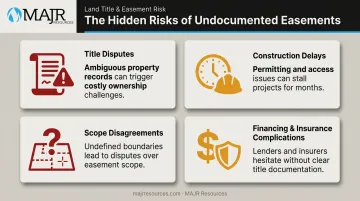
Getting the mode right establishes the legal foundation for the entire access right, shaping whether it survives a title dispute, a resale, or a court challenge years later.
Modes of Easement Acquisition Explained
Easements aren't created identically in every situation. Whether one exists, and how strong it is, depends on whether there's a formal agreement, a documented history of use, or a legal necessity tied to how the land was divided.
Each mode carries different proof requirements, negotiation dynamics, and risk profiles. Here's how the five primary modes break down.
Express Grant (Written Agreement or Deed)
An express grant is an easement deliberately created through a signed, typically recorded agreement between the landowner and the party seeking the right. The terms are negotiated up front: location, purpose, duration, and compensation, then executed and recorded against the property.
Express easements generally must be in writing to satisfy the Statute of Frauds. Recording, meanwhile, mainly governs notice and priority against later purchasers rather than validity between the original parties, meaning an unrecorded but properly executed agreement can still bind the original grantor.
Best suited for: Planned infrastructure and energy projects, such as pipeline, road, or utility right-of-way, where terms need to be defined clearly before construction begins.
Key strength: Clearest, most enforceable, and most easily transferable easement type, since everything is documented and searchable in the property record.
Trade-off: Requires successful negotiation and landowner cooperation. That can take time and money if the landowner isn't motivated to sign.
Easement by Necessity
This easement is implied by law when a parcel becomes landlocked after a larger tract is divided, leaving no legal access to a public road. Courts imply the right based on necessity, not agreement.
The standard is strict. Courts generally require:
- Unity of ownership before the parcels were separated
- Severance into separate ownership
- Necessity existing at the time of severance
Notably, courts have held that necessity means legal landlocking, not mere inconvenience. If alternative access exists but is expensive or impractical, that typically won't qualify.
Best suited for: Landlocked parcels created through subdivision or partition where access wasn't addressed at the time of sale.
Key strength: Guarantees access even without landowner consent.
Trade-off: Strictly limited to true necessity, and it terminates once alternative legal access becomes available.
Easement by Prescription
A prescriptive easement is acquired through long-term, continuous, open, and adverse use of another's land without permission, similar in concept to adverse possession. The use must be uninterrupted for a statutory period set by state law.
State timelines vary widely:
- Wyoming requires 10 years of adverse use under a claim of right
- Michigan requires 15 years of open and notorious use
- Maine requires 20 years of uninterrupted use before a right-of-way can be acquired
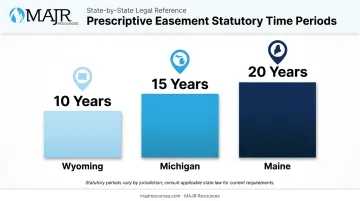
These examples show the range, not a universal national standard, so the applicable state's statute always controls.
Best suited for: Longstanding, unrecorded access routes that predate any formal documentation.
Key strength: Can validate access even without a single written record.
Trade-off: Proving strict statutory elements in court is evidence-heavy, time-consuming, and uncertain. Permission from the landowner, at any point, can defeat the claim entirely.
Easement by Implication (Prior Use)
This mode is inferred from the circumstances of a property division. If a use, such as a shared driveway or drainage path, existed before the land was split and remains reasonably necessary afterward, courts may recognize an implied easement.
Courts typically look for:
- Common ownership before severance
- A use that was apparent, visible, and continuous, not casual or temporary
- Evidence the original owner intended the use to continue
- Reasonable necessity for the dominant parcel's enjoyment
Unlike easement by necessity, this mode doesn't require strict necessity. It only requires that the use was apparent and beneficial before the parcels separated.
Best suited for: Subdivided properties where pre-existing infrastructure, like drainage or utility lines, served both parcels before division.
Key strength: Preserves practical arrangements without requiring a brand-new written agreement.
Trade-off: Difficult to prove without clear historical documentation, and the required degree of necessity varies by jurisdiction.
Easement by Condemnation (Eminent Domain)
This is an easement acquired by a government entity, or an authorized private company such as a utility or pipeline operator, through eminent domain in exchange for just compensation.
Under federal law, a holder of a FERC certificate may condemn necessary interstate pipeline right-of-way only after it can't acquire the interest by contract or agree on compensation. In other words, the certificate doesn't eliminate the negotiation step. It functions as a backstop for use only when negotiations fail. State statutes, such as those authorizing common carriers in Texas, follow a similar structure.
Best suited for: Large-scale infrastructure, pipeline, transmission line, and public utility projects where a single holdout landowner could otherwise block the entire project.
Key strength: Ensures project continuity for public-purpose or utility-designated projects, even without full landowner agreement.
Trade-off: Involves formal legal proceedings, compensation disputes, and regulatory scrutiny that can extend timelines by months or years.
How to Determine Which Mode of Acquisition Applies to Your Project
Companies acquiring right-of-way can't assume a mode applies just because it seems logical. Confirming it requires checking documentation, land history, and project goals against each legal standard.
A practical review sequence looks like this:
- Check existing title records, deeds, and surveys to see if an express easement already exists on the property.
- Trace the parcel's history to determine if it was ever part of a larger tract that was subdivided — a signal that necessity or implied easements may apply.
- Look for visible, long-term use of a route or access point, which could support a prescriptive claim if it's been continuous and unpermitted for the statutory period.
- Evaluate condemnation authority under applicable state or federal statute, and confirm whether negotiation must be attempted first (it usually must).
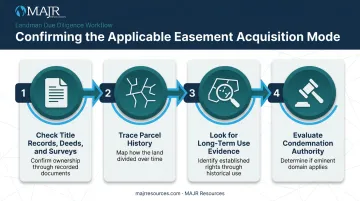
This is where experienced landman and title due diligence work becomes critical. MAJR Resources supports this process directly:
- Conducts chain-of-title research to confirm rightful ownership
- Reviews recorded deeds and plat maps for existing easements or restrictions
- Applies GIS-based analysis to map parcel history and access rights before a project reaches final design
That groundwork determines whether a company should proceed with negotiation, rely on an existing right, or prepare for a condemnation filing.
Common Pitfalls to Avoid When Establishing an Easement
Even experienced developers run into avoidable problems. The most frequent ones include:
- Assuming an easement exists based on verbal understanding. Informal agreements between neighbors or predecessors rarely hold up without title confirmation.
- Failing to properly record an express easement. An unrecorded agreement may bind the original parties, but it creates real risk around enforceability and transferability down the line.
- Overlooking state-specific statutory periods. Prescriptive and necessity requirements vary by jurisdiction — a route that qualifies in Wyoming might fall short of Maine's 20-year threshold.
- Treating inactive easements as expired. A recorded easement doesn't disappear just because it hasn't been used recently; it stays attached to the land until formally released.
- Overlooking legal description mismatches. When a survey reveals boundaries that don't match the recorded easement language, it can invalidate or complicate the right's scope.
Each of these gaps tends to surface at the worst possible time: during due diligence, financing, or resale, when there's the least flexibility to fix them.
Conclusion
Easements come from several distinct legal pathways, and each one carries its own requirements, protections, risks, and limitations. Express grants offer the clearest and most negotiable path. Necessity, prescription, and implication arise from circumstance rather than agreement. Condemnation exists as a last resort when negotiation fails and a public-purpose project needs to move forward.
Identifying the correct mode early protects a project against disputes and costly title complications that are far more expensive to untangle later. Partnering with experienced land and title professionals, like the team at MAJR Resources, ensures the right mode is properly documented and enforceable from the outset.
Frequently Asked Questions
What is acquisition of easement?
This is the legal process through which a party obtains the right to use another's land for a specific purpose. This can happen through express grant, necessity, prescription, implication, or condemnation, depending on the circumstances.
Can you acquire an easement?
Yes. Easements can be acquired through negotiated agreement, court action, long-term use, or eminent domain, depending on the situation and applicable state law.
What are the main ways to acquire an easement?
The five primary modes are express grant, necessity, prescription, implication, and condemnation. Each has distinct proof requirements and arises under different circumstances.
How long does it take to establish an easement by prescription?
Most states require continuous, open, and adverse use for a statutory period, commonly ranging from 10 to 20 years depending on the jurisdiction. The exact period, and what counts as "adverse," varies by state.
Does an easement transfer when the property is sold?
Easements appurtenant generally run with the land and transfer automatically to new owners. Easements in gross benefit a person or entity rather than a parcel, so transfer depends on the original grant and state law.
What is the difference between an easement and a right-of-way?
An easement is the broader legal category covering various land use rights, including drainage, utilities, and access. A right-of-way is a specific type of easement that grants passage over land, usually for roads, pipelines, or utility corridors.