Introduction
A landowner opens an envelope and finds a lease offer marked "paid up." The bonus number looks good. But what does "paid up" actually mean for the next five or ten years of ownership?
Many mineral owners and small operators struggle with this exact question. Oil and gas leases are dense legal documents. Misreading a "paid up" clause can lead to a missed payment stream, an unexpectedly long holding period, or a signed agreement that looks better on paper than it performs in practice.
This guide breaks down what a paid-up lease actually is and how the bonus, rental, and royalty payments work together. It also covers which clauses deserve your attention before you sign and how this structure stacks up against the older delay-rental model.
Key Takeaways
- A paid-up lease pays all consideration upfront, eliminating annual delay rentals during the primary term
- "Paid up" changes payment timing only — it doesn't guarantee drilling will happen
- Lease value comes from combining the bonus, royalty wording, and clauses like Pugh and retained acreage
- Title verification and negotiation support help both sides avoid costly oversights
What Is a Paid-Up Oil and Gas Lease?
A paid-up oil and gas lease is a lease structure where the lessee (the energy company) pays the full consideration, meaning the bonus plus the value of what would otherwise be periodic delay rentals, in one lump sum at signing. That single payment keeps the lease active for the entire primary term. No further rental checks are required.
Compare that to the primary term itself. This is the initial window, set by the lease's habendum clause, during which the lessee holds the right to explore and drill. If production begins before the primary term ends, the lease moves into its secondary term and stays active "as long thereafter" as production continues.
Here's the misconception worth clearing up: a paid-up structure only changes when the money moves. It does not commit the company to drilling on any particular schedule during the primary term. A mineral owner could still wait out the full primary term with no rig ever showing up, even after cashing a paid-up check.
Example: An heir who owns a fractional mineral interest inherited from a grandparent receives one upfront payment covering the full five-year primary term, instead of five separate annual rental checks that could easily go to the wrong address after a move.
Types of Oil and Gas Leases (Where Paid-Up Fits)
Landowners typically encounter these lease-related terms:
- Paid-up lease: full consideration paid at signing, no separate delay rentals
- Delay rental lease: drilling deferred year to year, contingent on timely rental payments
- Top lease: a new lease covering minerals already under an existing "bottom" lease, set to take effect only if that lease expires or terminates
- Surface and mineral estates: these describe ownership rights and access, not a payment structure, though they're often bundled into the same lease discussion
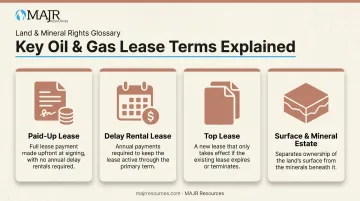
Lease terminology varies by state and by the operator drafting the form. Always review the actual document rather than assuming based on category labels alone.
How a Paid-Up Lease Works: Bonus, Rentals & Royalty
Three separate payment types show up in a paid-up lease, and mineral owners sometimes conflate them.
The signing bonus. This is the upfront payment, typically quoted per net mineral acre. Watch for a proportionate reduction clause (also called a lesser-interest clause). If your actual ownership turns out to be less than what the lease represents, this clause adjusts your bonus, royalty, and other payments downward to match your real interest.
Why delay rentals disappear. In a traditional delay-rental lease, the lessee pays annually to postpone drilling, and a late or missed payment can terminate a Texas "unless" lease outright.
A paid-up structure folds that rental value into the upfront bonus, removing the recurring deadline entirely. That's less paperwork for multi-owner or heir-held tracts, and fewer disputes over a missed check.
The royalty clause stands apart. Royalties are a percentage of production revenue, paid only after a well actually produces rather than at signing. Historically, 12.5% (1/8) was the standard royalty fraction in Texas, though Texas A&M's Real Estate Research Center reports negotiated rates commonly running 20% to 25% in more recent leasing activity.
The nominal royalty fraction alone doesn't tell the full story. Language on post-production cost deductions (transportation, processing, compression) can reduce your effective royalty check significantly, even at a stated 25%.
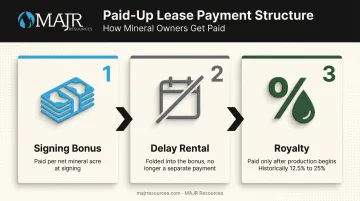
Payment mechanics to watch:
- Confirm the timing of payment relative to the signing date
- Check whether a title review period delays disbursement
- Verify whether payment is conditioned on completed curative title work
Paid-Up Lease vs. Delay Rental Lease
| Factor | Paid-Up Lease | Delay Rental Lease |
|---|---|---|
| Primary-term rentals | Paid upfront, no annual obligation | Separate payment due each anniversary |
| Missed-payment risk | Eliminated | Late or missed payment can terminate the lease |
| Administrative burden | Lower, especially for multi-owner tracts | Higher, requires annual tracking |
| Current market prevalence | Dominant | Less common |
Neither structure is automatically "better." A paid-up lease with a weak royalty clause and no Pugh protection can still be a poor deal. The full package, including term length, royalty wording, and release clauses, matters more than payment timing alone.
That said, Practical Law notes that most modern oil and gas leases are structured as paid-up agreements, with no separate delay-rental clause at all. Operators favor this approach because it removes the termination exposure tied to a missed or defective rental payment, which is a real risk when tracking dozens or hundreds of owners across a project area.
Key Clauses, Lease Term & Going Rate to Watch For
Primary terms commonly run 1, 3, 5, or 10 years. The State Bar of Texas describes a 3-year term as very common, while Texas A&M's research center found an average negotiated range of 3 to 5 years. Terms can stretch longer in some markets, so confirm the specific number rather than assuming.
Bonus rates vary by region, geology, and how competitive the local leasing market is at that moment. Public land auction results give a sense of the spread. One West Texas university lands sale averaged roughly $2,700 per acre, with some tracts bidding above $12,000 per acre.
Those numbers mark auction floors and ceilings, though, not a private mineral owner benchmark. Check recent comparable activity in your specific county before treating any single figure as the going rate.
Clauses That Deserve Real Attention
- Royalty wording: gross vs. net proceeds, and what deductions are allowed
- Pugh clause and depth severance: releases acreage or depths outside a producing unit instead of letting one well hold your entire tract
- Pooling limits: how much acreage the operator can combine into a single unit
- Shut-in royalty terms: payment and time limits for wells capable of producing but not yet selling
- Retained acreage and continuous development requirements: how much land the lessee keeps once a well is producing, and how quickly they must keep drilling to hold more
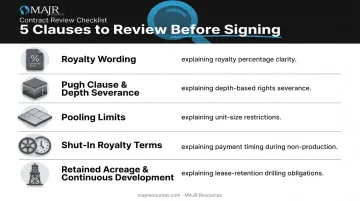
Why Title Accuracy Comes First
Confirming mineral ownership before signing prevents proportionate reduction surprises and disputed payments down the line. This is where experienced landman support earns its keep.
MAJR Resources' full-title research process traces the chain of title back to the original grant and verifies legal descriptions. It also identifies liens or gaps in ownership before a lease is ever executed, the kind of groundwork that catches a fractional-interest error before it becomes a payment dispute.
For multi-owner or multi-regional acquisitions in particular, involve a mineral rights attorney or landman professional to review the offer before signing. A clause that looks standard in one state can carry very different consequences in another.
Advantages, Drawbacks & Red Flags of a Paid-Up Lease
Advantages for lessors: immediate lump-sum cash, and simpler administration for estate-held or multi-heir tracts where tracking annual rental payments across several owners gets messy fast.
Advantages for lessees: reduced risk of losing a lease over a missed rental payment, and faster acquisition when assembling many tracts at once.
Drawbacks and red flags to watch for:
- A long primary term with no Pugh clause or retained acreage protection
- Broad pooling authority with no acreage cap
- Royalty language that permits extensive post-production deductions
- Vague signature block requirements for trusts, estates, or business entities
MAJR Resources' due diligence work (including curative document drafting, division order review, and heir-location services) is built to catch these issues before signing, not after a disputed payment shows up months into production.
Affidavits of heirship, ratification agreements, and lienholder subordination agreements all resolve title defects that would otherwise surface as ownership conflicts once revenue starts flowing.
Frequently Asked Questions
What is the going rate for oil and gas leases?
Bonus rates vary widely by region, geology, and current market activity. Check recent comparable lease activity in your specific county or area for an accurate range rather than relying on national averages.
How do you negotiate an oil and gas lease?
Start by confirming your actual ownership interest, then compare bonus and royalty terms together rather than in isolation. Negotiate protective clauses like Pugh, pooling limits, and retained acreage before signing.
What is the maximum term for an oil and gas lease?
Primary terms commonly range from 1 to 10 years depending on the lease form and regional norms. The secondary term continues only as long as production or another qualifying condition is maintained.
What are the four types of leases?
Landowners commonly encounter paid-up leases, delay rental leases, top leases, and agreements distinguishing surface from subsurface (mineral) rights. Each addresses a distinct part of the leasing relationship, not four variations of one concept.
Is a paid-up oil and gas lease the same as a bonus lease?
They're related but not identical. The upfront payment in a paid-up lease typically includes both a true signing bonus and the value of the delay rentals it eliminates.
How is a paid-up lease payment calculated?
Payment is based on your net mineral acreage multiplied by the negotiated per-acre bonus rate. It's subject to proportionate reduction if your actual ownership differs from what the lease represents.