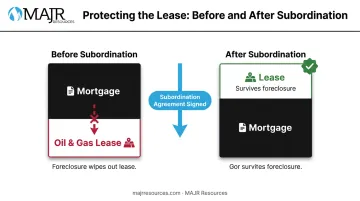
Under ordinary property law, that foreclosure can wipe out the lease entirely, well and all.
This is exactly the scenario subordination agreements are built to prevent. They protect the lessee's drilling investment and preserve the landowner's ability to keep leasing their minerals without scaring off operators. This article breaks down what subordination actually means, how the process works, what changed under Texas law in 2016, and why the same concept now shows up in solar and wind land deals across the state.
Key Takeaways
- Subordination agreements reorder lien priority so a lease survives mortgage foreclosure
- A lease dated after a mortgage is normally extinguished if that mortgage forecloses
- Texas Property Code Chapter 66 gives many leases automatic protection, but not surface rights
- Solar and renewable land deals use similar subordination agreements for surface and mineral owners
- An experienced landman catches liens early, before they threaten a well
What Is a Subordination Agreement in Oil and Gas Leasing?
A subordination agreement is a legal contract that reorders the priority between two competing claims on the same property, usually a lienholder's mortgage and an oil and gas lessee's leasehold interest. It doesn't create new rights. It simply changes who gets paid, or who wins, when there's a conflict.
Texas property law generally runs on a "first in time, first in right" rule. Whoever records their interest first typically outranks everyone who records later. A properly filed mortgage takes its place in line the moment the county clerk stamps it.
That creates a real problem for oil and gas leases. If a mortgage was recorded before the lease, the mortgage normally outranks it — even if the lease came years later and even if a well was drilled, completed, and put into production in the meantime.
If the lender forecloses, the lease can be extinguished along with everything the lessee built on the land.
Many leases include a clause letting the lessee pay off the lien directly to stop foreclosure. It sounds simple, but it's rarely practical:
- The lessee may not know the loan balance or terms
- Paying someone else's mortgage ties up capital better spent on operations
- It doesn't resolve the underlying priority problem for future defaults
A subordination agreement fixes this at the source. The lienholder formally agrees, in writing, that the lease will remain superior to the lien even though the lien was recorded first.
Strip away the legal language and it's straightforward: subordination means one party agrees to step behind another in priority. The bank voluntarily lowers its own claim so the lease stays intact no matter what happens to the mortgage. The mortgage still exists. It just can't take the lease down with it anymore.
Who Prepares a Subordination Agreement and Why It's Critical
The oil and gas company's landman or legal counsel typically drafts the subordination agreement, then sends it to the lienholder — usually a bank or mortgage servicer — for review and signature. The lienholder doesn't initiate this process. The lessee does, because the lessee carries the risk.
The financial exposure explains the urgency. Onshore wells in major U.S. plays like the Permian, Eagle Ford, and Bakken carry total capital costs of $4.9 million to $8.3 million per well, according to a U.S. Energy Information Administration analysis of upstream drilling and completion costs.
Losing a lease to foreclosure after that kind of spend, plus forfeited future royalty income, is not a rounding error.
Lenders sometimes cooperate readily. Here's why:
- Royalty income from a producing lease can help the landowner-borrower repay their loan
- A performing loan is better for the bank than a defaulted one
- Subordination costs the lender little if the mineral estate is generating cash flow
Other lenders push back hard. Residential mortgage holders, in particular, may see little upside:
- The loan balance often far exceeds any realistic royalty value
- The lender has no incentive to risk its lien position for someone else's benefit
- Loan officers may lack authority to approve nonstandard agreements without escalation
Things get slower still when a mortgage has been sold or securitized to a third-party servicer. Tracking down the right decision-maker, let alone getting a signature, can stretch a routine title fix into a months-long negotiation.
Proactive title work prevents this bottleneck. Landmen who identify liens before a lease is finalized, rather than after a well is drilled, give their clients far more leverage and far less exposure.
Texas Law Update: Statutory Subordination Under Property Code Chapter 66
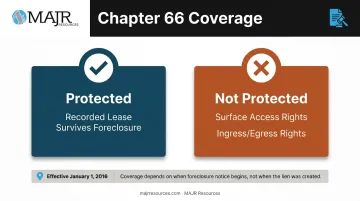
Texas changed the default rule in 2015. House Bill 2207, effective January 1, 2016, created Chapter 66 of the Texas Property Code, which automatically subordinates certain pre-existing mortgages to qualifying oil and gas leases.
Under the enrolled text of HB 2207, a recorded oil or gas lease remains effective after foreclosure if:
- It was recorded before the foreclosure sale
- It had not otherwise expired or terminated on its own terms
That's a meaningful safety net, but it comes with a critical carve-out: the statute protects the lease, not surface access.
If the mortgage had priority, foreclosure can still terminate the lessee's rights to use the surface, including ingress and egress to the well. You can keep your lease and lose your road to it.
One detail often gets misstated: Chapter 66 doesn't exempt every lien created before 2016. The transition rule turns on when foreclosure begins, not when the lien was created.
The statute applies to nonjudicial foreclosures where notice is given on or after January 1, 2016, or to judicial foreclosures commenced on or after that date, no matter how old the underlying mortgage is.
For operators drilling on a tract with existing surface use rights: don't assume statutory protection covers everything.
Pursue a negotiated subordination agreement that explicitly addresses surface access. This matters most for drillsite tracts, where losing ingress and egress would strand the well as effectively as losing the lease itself.
Subordination Beyond Mortgages: Surface Rights and Renewable Energy
Subordination isn't only about banks and mortgages. It shows up between surface owners and mineral owners too, and that overlap is becoming more common as renewable energy development spreads across Texas.
Texas mineral estates are legally "dominant" over the surface estate. A mineral lessee generally has the implied right to use as much of the surface as reasonably necessary for development. But that right isn't absolute. Under the accommodation doctrine, established in Getty Oil Co. v. Jones, the mineral lessee must exercise due regard for existing surface uses when a reasonable, industry-standard alternative exists that wouldn't interfere.
This matters for solar development. A surface owner planning a solar farm needs stable, uninterrupted use of large tracts of land. But if a mineral owner or lessee still holds dominant rights to drill sites, access roads, and pipelines on that same tract, the picture changes. The solar project's stability then depends on getting those rights subordinated or clearly defined in advance.
Texas solar capacity hit roughly 16 GW by the end of 2023, with developers planning approximately 24 GW more in additions through 2024 and 2025, according to EIA data on utility-scale solar capacity growth. That kind of buildout is colliding with mineral estates across the state.
Solar developers typically address the risk through:
- Designated drill-site and access corridors that carve out predictable zones for future mineral operations
- Setbacks and surface-use waivers negotiated directly with mineral owners or lessees
- Subordination or accommodation agreements that lock in noninterference terms before construction begins
Courts have made clear this isn't automatic. In Lyle v. Midway Solar, LLC, mineral owners tried to block a solar project, but the court found no active mineral operations existed on the record to trigger accommodation. The lesson: address subordination and surface priority proactively, not after a dispute erupts.
This is where working across both traditional oil and gas and renewable energy land services pays off. MAJR Resources supports clients on both sides of these negotiations — representing mineral owners protecting future drilling access, or solar developers securing project certainty.
Navigating a Subordination Agreement: Steps and Professional Support
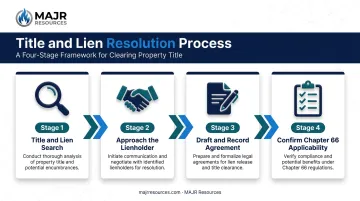
Getting a subordination agreement in place, and getting it right, follows a fairly consistent path:
- Run a title and lien search first. Before finalizing a lease, check both the mineral and surface estate for existing mortgages or other liens. This is the single best way to avoid discovering a problem after a well is already producing.
- Approach the lienholder directly. Present the request clearly: the lease should take priority over the lien in the event of foreclosure, and explain why cooperation benefits the lender too.
- Draft the agreement with precise language. Address both lien priority and surface use rights explicitly, then get it properly executed and recorded in the county real property records.
- Check whether Chapter 66 already applies for Texas tracts. Even where it does, evaluate whether a supplemental agreement is still needed to protect surface access, since the statute doesn't cover that piece.
None of these steps are especially complicated on paper. In practice, they require someone who knows how to read a title chain, spot an encumbrance buried in county records, and follow up with a lienholder who has no particular urgency to respond.
This is the core of what a landman does. MAJR Resources' team handles this due diligence and negotiation work for energy clients, from verifying mineral title to reaching out to lienholders. This proactive work helps operators avoid costly delays and lease-forfeiture risk that come from discovering a lien problem after the rig has already moved off location.
Frequently Asked Questions
Who prepares a subordination agreement for an oil and gas lease?
The lessee's landman or attorney typically prepares the agreement and sends it to the lienholder for review and signature. The lienholder rarely initiates the process on their own.
What does subordination mean in an oil and gas lease?
It means reordering lien priority so the lease survives even if an earlier-recorded mortgage is later foreclosed. The lienholder agrees to rank behind the lease instead of ahead of it.
What is a Pugh clause in an oil and gas lease?
A Pugh clause limits held-by-production acreage to the producing unit, releasing the rest of the leased acreage after the primary term. It's unrelated to lien priority but often confused with subordination.
Is a subordination agreement the same as a ratification?
No. Subordination changes lien priority between competing claims. Ratification confirms or approves an existing lease or interest, and it doesn't touch priority at all.
What happens if a lienholder refuses to sign a subordination agreement?
The lessee bears foreclosure risk unless a statute like Texas Chapter 66 offers protection. Companies mitigate this through early title diligence and, where possible, negotiating alternate terms.
Does Texas law still require subordination agreements today?
Chapter 66 automatically protects many qualifying leases after foreclosure, but subordination agreements are still recommended for surface rights and for liens tied to foreclosures that predate the statute's coverage.