Upfront cost is one of the most common roadblocks companies run into when evaluating a system, but it's rarely the only one. Financing structure, tax exposure, and property control all factor in too.
Here's the good news: you don't need cash on hand to go solar. Leases, power purchase agreements (PPAs), loans, cash purchases, and C-PACE financing each shift ownership, tax benefits, and risk in different directions. This guide breaks down each option, compares trade-offs, and walks through a framework for choosing the right fit — including a step most businesses forget until it's too late: verifying land title and mineral rights before signing.
Key Takeaways
- Five main financing paths exist: cash purchase, loans, leases, PPAs, and C-PACE
- Leases and PPAs require zero upfront capital but forfeit direct tax incentives
- Cash purchases and loans deliver the strongest long-term returns for capital-rich businesses
- The right structure depends on your tax position, cash flow, and hold time
- Verify land title and mineral rights before signing ground-mounted lease agreements
What Is Commercial Solar Financing?
Commercial solar financing covers the contractual and funding structures businesses use to install solar without writing a check for 100% of the system cost on day one. It splits into two broad camps.
Ownership models, like cash purchases and solar loans, put the system on your books. You own the panels, you own the tax benefits, and you're on the hook for maintenance.
Third-party ownership models, like leases, PPAs, and C-PACE, shift some or all of that ownership elsewhere. A developer or financier holds the asset (or secures the debt against your property), and you pay for access to the power or the equipment.
The financing decision matters almost as much as the decision to go solar in the first place. It determines:
- Whether the credit shows up as debt or an operating expense on your balance sheet
- Who claims the federal tax credit and depreciation
- How predictable your monthly cash flow looks
- How much total savings you capture over the system's life
Types of Commercial Solar Leases and Financing Options
There's no universal "best" structure. The right one depends on how much capital you can deploy, your appetite for tax credits, your credit profile, and how long you expect to occupy or own the property.
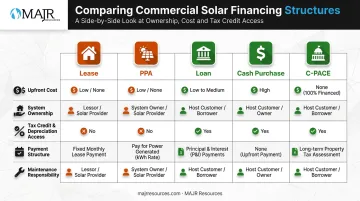
What separates these five options mostly comes down to three questions: Who owns the system? How are payments calculated? And who captures the available tax incentives?
Commercial Solar Lease
A commercial solar lease is a third-party ownership arrangement. A developer installs, owns, and maintains the system, and your business pays a fixed monthly rate to use it.
How it works:
- Zero upfront cost
- Fixed contract term, commonly spanning 10 to 20+ years
- Performance provisions and end-of-term buyout options are negotiated case-by-case
- Monthly payment stays flat regardless of how much power the system actually produces
That last point is the key distinction from a PPA. A lease charges you for equipment access — the bill doesn't move whether the sun cooperates or not.
Best for: Businesses that want predictable budgeting, zero maintenance responsibility, and no interest in owning the hardware or chasing tax credits directly.
Strengths:
- $0-down access to solar
- No maintenance obligations
- Payments you can forecast a decade out
Trade-offs: You can't claim the Investment Tax Credit or depreciation, as the lessor keeps those benefits. Selling or subletting the property can also get complicated, since the lease may need to transfer to a new owner or tenant.
Power Purchase Agreement (PPA)
A PPA looks similar to a lease on the surface, but the payment math is different. A developer installs and owns the system, and your business buys the electricity it generates at a fixed per-kWh rate — typically over a 10 to 25-year term.
Instead of a flat monthly bill, your cost fluctuates with actual output. Sunny months cost more, cloudy months cost less.
Best for: Companies that want to pay only for energy actually produced with a rate structured below retail.
Documented case studies show this discount can land around 10% below utility rates, such as a BJ's Wholesale Club project cited in a Department of Energy financing guide. However, actual savings vary by site and contract.
Strengths:
- No upfront cost
- Developer absorbs operational and performance risk
- Some contracts allow an early buyout
Trade-offs: Monthly costs are harder to forecast than with a lease, and you don't capture tax incentives directly—those stay with the system owner.
Commercial Solar Loan
A solar loan is debt financing. You own the system immediately, and you spread the cost over a term — commonly 5 to 15 years, based on EPA financing benchmarks, though some lenders extend longer.
Some loan products split into two tranches: a short-term bridge loan (often 12–18 months) sized to the expected tax credit, paired with a longer amortizing loan for the balance. Rates can be fixed or variable depending on the lender.
Ownership is the defining feature here. Unlike a lease or PPA, you keep every tax benefit.
Best for: Businesses with enough tax appetite and credit strength to want maximum long-term ROI without paying the full cost in cash upfront.
Strengths:
- Full system ownership from day one
- Direct access to the federal tax credit and depreciation
- Strong long-term return once the loan is paid off
Trade-offs: Interest adds to the total project cost, and you're responsible for all maintenance for the life of the system.
Direct Cash Purchase
This is the simplest structure: pay for the system outright and own it from day one. Payment typically follows milestones — a deposit, a payment at equipment order, and a final payment at energization.
Best for: Businesses with available capital that plan to stay in the property long-term and want the fastest payback with no financing drag.
Strengths:
- No interest costs eating into savings
- Full access to tax credits, depreciation, and any renewable energy certificate revenue
- Added property value from an owned energy asset
Trade-offs: This option requires significant capital upfront, and full responsibility for operations and maintenance sits with you.
Payback timing is highly site-specific — it depends on your utility rate, system size, local incentives, and how fast retail electricity prices climb. There's no single national number that applies everywhere, so ask any installer for a cash-flow model built around your actual usage.
Commercial Property Assessed Clean Energy (C-PACE)
C-PACE is government-enabled financing repaid through a voluntary assessment added to your property tax bill. It can cover up to 100% of project cost with no upfront payment, and approval is based on property value rather than your business credit score.
The defining feature: the property owner keeps ownership and tax benefits, while the debt is secured against the property itself — meaning it can transfer to a new owner if the property sells.
Best for: Commercial property owners — office, retail, industrial, hospitality — who want the longest repayment terms available and don't want the deal to hinge on personal or business credit.
Strengths:
- Among the longest repayment terms of any option
- Structured in a way that can keep the obligation off traditional balance-sheet debt
- Full retention of tax incentives
Trade-offs: This financing is only available where local C-PACE programs are active, as rules vary widely. The lien can also complicate refinancing, since existing mortgage holders typically need to consent first.
How to Choose the Right Commercial Solar Financing Option
The right choice depends on your specific financial and operational position, not on whichever option is most common in your industry.
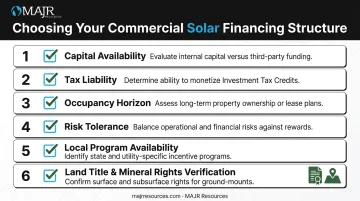
Weigh these factors before you commit:
- Capital availability. Can you absorb the upfront cost, or does your cash flow favor predictable monthly payments instead?
- Tax liability. Do you have enough tax appetite to actually use the Investment Tax Credit and depreciation, or would that value go to waste?
- Occupancy horizon. How many more years do you expect to own or lease this property? Match the contract length to that window.
- Risk tolerance. Are you comfortable owning maintenance and performance risk, or would you rather hand that off to a developer?
- Local program availability. C-PACE and certain lease/PPA structures aren't offered everywhere, so check what's active in your state before building a plan around them.
Don't Skip Land and Title Due Diligence
Here's a step that gets overlooked constantly, especially on ground-mounted projects: verifying who actually controls the land before you sign anything.
Mineral rights are frequently severed from surface rights, meaning a landowner can sign a solar lease without realizing a separate party holds subsurface rights that could conflict with the installation. Pipeline easements, transmission corridors, and unresolved chain-of-title gaps can all derail a project mid-construction.
This is where specialized landman and title research services come in. MAJR Resources, for example, has spent two decades running chain-of-title research, mineral rights verification, and easement checks for energy companies in Texas and beyond. The firm helps confirm clean title and resolve encumbrances before a business commits to a multi-decade solar agreement.
That verification work applies just as directly to a 20-year solar lease as it does to an oil and gas lease.
What to Check Before Finalizing a Solar Lease or Financing Agreement
A few mistakes show up again and again in commercial solar deals. Watch for these before you sign:
- Overcomplicating the structure. A C-PACE arrangement or split loan sounds appealing, but if a straightforward loan or cash purchase gets you to the same goal, don't add complexity for its own sake.
- Buried contract terms. Escalator clauses, buyout pricing, and early termination fees often hide deep within lease or PPA agreements. Read them line by line, not just the summary page.
- Ignoring the full cost picture. Interest charges, dealer fees, and property tax assessment increases tied to C-PACE all add up. Model the total cost, not just the monthly payment.
- Skipping title and mineral rights verification. For ground-mounted projects, confirming clean title upfront can prevent delays, redesigns, or a project falling apart months into development. MAJR Resources performs this same verification work for energy land deals, whether oil and gas leases or solar arrays.
Conclusion
There's no single right way to finance commercial solar — the best fit depends on your priorities:
- Lease: Best for businesses that want predictability and zero maintenance
- PPA: Fits companies that prefer to pay only for what they use
- Loan or cash purchase: Makes sense when tax capacity and capital line up
- C-PACE: Serves property owners chasing the longest repayment runway
Understanding how ownership, tax treatment, and risk shift between these structures leads to a smarter, longer-term decision — one that fits your business instead of a generic template.
Whichever structure you choose, pair it with solid land and title due diligence. This is the kind of chain-of-title research and mineral rights verification MAJR Resources performs for energy clients across Texas and beyond. Confirming clean title before signing sets a commercial solar project up for a smooth, uninterrupted path to production.
Frequently Asked Questions
How much does a 25-year solar commercial lease cost?
Total cost depends heavily on system size, local utility rates, and the specific contract terms, so there's no fixed national figure. Ask your developer for a cash-flow model covering the monthly rate, any escalator, and end-of-term buyout pricing.
What is the 20% rule for solar?
It's the "80/20" IRS retrofit rule: a facility still counts as newly placed in service if reused equipment stays under 20% of its total value. That's a facility-by-facility test, not a spending threshold for tax credit eligibility.
How do companies make money from solar commercial leases?
Lessors earn revenue from your monthly lease payments while also retaining ownership of the system, which lets them claim the federal tax credit and depreciation. They also benefit from the long-term production value of the equipment.
What's the difference between a commercial solar lease and a PPA?
A lease charges a fixed monthly rate for using the equipment, regardless of output. A PPA charges per kilowatt-hour of electricity the system actually produces, so the bill moves with production.
Can a business cancel a commercial solar lease early?
Most contracts include early termination provisions, and terms vary widely by provider. Review the buyout and termination clauses carefully before signing, since exit costs can be significant.
Do commercial solar leases qualify for tax incentives?
The leasing company, as the system's legal owner, typically claims the federal Investment Tax Credit and depreciation — not the business using the power. Some providers factor that value into a lower lease rate, but it isn't passed through directly.