In 2024, Texas produced more than two-fifths of all U.S. crude oil and accounted for 28% of national natural gas withdrawals, with gas production hitting a record 13 Tcf, according to the U.S. Energy Information Administration. None of that happens without a signed lease granting a company the right to drill.
Yet plenty of mineral owners, and even some smaller operators, don't fully understand what happens between the first landman phone call and the first royalty check. That gap costs people negotiating leverage and creates avoidable delays.
This guide walks through exactly how Texas oil and gas leasing works, step by step, not just the legal theory behind it.
Key Takeaways
- A Texas lease grants temporary drilling rights for a bonus and royalty, not permanent ownership
- The process follows a set sequence: title research, negotiation, state permitting (RRC), drilling, and royalty payment
- Texas treats minerals as the "dominant estate," giving owners strong legal footing
- Royalties typically range from 1/8 to 1/4 of production value, depending on competition and location
- Fractured or inherited mineral titles cause more leasing delays than any other single factor
What Is an Oil and Gas Lease in Texas?
An oil and gas lease is a contract between a mineral owner (the lessor) and an energy company (the lessee). It grants the lessee the right to explore for, drill, and produce oil and gas from the property for a defined period. In exchange, the lessor receives an upfront bonus payment and an ongoing royalty on production.
This is not a sale. You still own your minerals. The lease simply separates the right to develop those minerals from the right to own them, letting a company access your resources without buying your land or your mineral estate outright.
Texas law adds a wrinkle that surprises many landowners: the mineral estate is legally treated as the dominant estate. That means a mineral owner, or the company leasing from them, can use as much of the surface as is "reasonably necessary" to explore and produce, even over a surface owner's objections.
This right isn't unlimited, though: excessive or negligent surface use can still create liability.
Beyond surface-use rights, leasing here runs on a dual track most other states don't have. County courthouse recording establishes legal title, but the Texas Railroad Commission (RRC) governs almost everything that happens once drilling starts, from permitting to spacing to pooling.
Types of Leases Common in Texas
Two lease structures dominate the market:
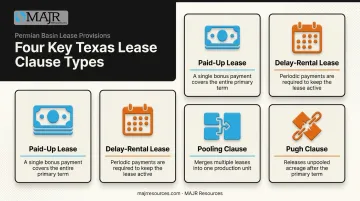
- Paid-up leases – The signing bonus covers the entire primary term. No separate rental payments are due, though production or another savings clause is still required to keep the lease alive afterward.
- Delay-rental leases – If drilling hasn't started, the company must make periodic (usually annual) payments to keep the lease active. Miss a payment on an "unless" lease, and it can terminate automatically.
Two more clauses show up constantly in Texas shale leases:
- Pooling clauses let an operator combine acreage from multiple leases into one production unit, a necessity for horizontal drilling across the Permian and Eagle Ford.
- Pugh clauses limit how much of your acreage a company can hold via pooled production, releasing unpooled acreage after the primary term expires.
How Does Oil and Gas Leasing Work in Texas?
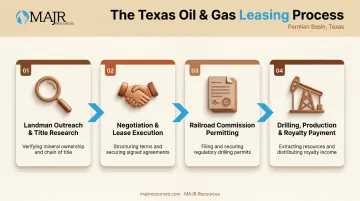
Texas leasing moves through a predictable sequence: title research, negotiation, regulatory permitting, and finally production. The Railroad Commission touches multiple points along the way, not just the drilling phase.
Initiation: Landman Outreach & Title Research
The process typically starts when a landman, working for an operator or a land services firm, identifies mineral owners tied to a target formation. This work relies on county courthouse deed records and GIS mapping to pinpoint who actually owns what.
This stage is research-heavy. Landmen verify chain of title, confirm exact ownership percentages, and untangle fractional interests, which are extremely common in Texas after generations of inheritance without formal probate.
Specialized firms like MAJR Resources approach this by layering courthouse deed and probate research with GIS spatial analysis and online databases (including RRC records) to confirm whether a target tract is already held by production or tied up in an existing pooled unit.
The output is a mineral ownership report identifying exactly who needs to sign, their ownership share, and how the signature block should be structured for trusts, estates, or business entities.
The most common bottleneck? Clouded or fractured title. A single tract split among a dozen heirs can stall a project for months while ownership gets sorted out.
Core Operation: Negotiation & Lease Execution
Once title is clear, negotiation begins on four central terms:
- Signing bonus per net mineral acre
- Royalty percentage on future production
- Primary term length
- Key clauses, including pooling, Pugh, and depth provisions
The actual sequence runs through offer, counteroffer, and review of any lease addenda, commonly an Exhibit A that lays out special stipulations. Once both sides agree, the lease is executed and a memorandum is recorded at the county courthouse.
This stage matters more than most owners realize. The speed of title clearance and negotiation directly determines how quickly an operator can assemble enough contiguous acreage to justify drilling a unit. Slow title work on even one tract can hold up an entire drilling program.
Regulation & Control: Texas Railroad Commission Oversight
Once acreage is leased, the operator still can't touch the surface. They must first obtain a Form W-1 drilling permit from the Railroad Commission before any drilling activity begins.
The RRC's oversight includes:
- Statewide Rule 37, setting default well spacing of 467 feet from a lease line and 1,200 feet between wells in the same reservoir
- Statewide Rule 38, requiring 40-acre density per well unless an exception is granted
- Form P-12 filings, required when multiple leased tracts get pooled into a single unit, certifying pooling authority under the Texas Natural Resources Code
The RRC handles permitting and spacing, but it does not adjudicate lease disputes, ownership questions, or royalty disagreements. Those remain private legal matters between lessor and lessee.
Output: Drilling, Production & Royalty Payments
With a permit in hand, the operator drills, completes the well, and connects it to gathering or pipeline infrastructure. At that point, the lease shifts from its primary term into a producing secondary term, kept alive as long as the well produces in paying quantities.
Once production starts, a division order is established, laying out each owner's percentage share. Royalty checks are then calculated from three inputs: production volume, sales price, and the owner's royalty percentage.
RRC data shows the scale of this final stage: December 2024 production reports came from 158,989 oil wells and 83,536 gas wells statewide, according to the Railroad Commission's own statistics. Each one of those wells started with a signed lease.
Where Oil and Gas Leasing Is Most Active in Texas
Leasing activity concentrates around three regions, each with distinct dynamics.
The Permian remains the most active play in the country. Production varies sharply across all three regions, as shown below:
| Region | Primary Resource | 2025 Output | Defining Trend |
|---|---|---|---|
| Permian Basin (West Texas) | Crude oil | 6.6M bbl/day (48% of U.S. crude production) | Falling rig counts despite rising output — a sign of efficiency gains, not more wells |
| Eagle Ford Shale (South Texas) | Oil and natural gas | 1.2M bbl/day oil; ~7.0 Bcf/day gas | Mature, steady producer |
| Haynesville (East Texas/Louisiana border) | Natural gas | ~15 Bcf/day, combined Texas-Louisiana | Primarily a gas play |
The Permian figures come from 2025 EIA reporting covering Texas and southeastern New Mexico. MAJR Resources' home base of Monahans sits inside this same Permian activity, giving the team direct, on-the-ground visibility into how leasing terms shift as the play matures.
What makes a specific tract attractive within these plays:
- Proximity to existing, proven production
- Formation depth and thickness suited to horizontal drilling
- Access to gathering lines and pipeline takeaway capacity
Bonus size and royalty competitiveness shift depending on whether an area is in early exploration or mature, infill development. Early-stage plays often see fiercer bonus competition; mature basins tend to compete more on royalty terms and drilling commitments.
Key Financial Terms: Bonuses, Royalties & Lease Length in Texas
Every Texas lease boils down to a handful of negotiable terms, and understanding each one changes how you evaluate an offer.
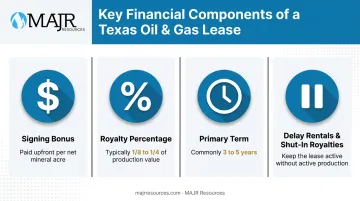
Signing bonus: Paid upfront, per net mineral acre, regardless of whether drilling ever occurs. Bonus size depends on three factors:
- Acreage controlled – larger, contiguous blocks typically command better per-acre rates
- Proximity to proven production – offset acreage near active wells draws premium bonuses
- Operator competition – more companies bidding on the same play pushes bonuses higher
There's no fixed statewide rate. Comparing multiple offers is the only reliable way to gauge fair market value in your area.
Royalty percentage: Historically set at 1/8 (12.5%), though 20-25% has become more common in competitive plays. Your royalty check is calculated as:
Production Volume × Sales Price × Royalty Percentage = Royalty Payment
Primary term: Commonly 3 to 5 years in modern Texas leases, down from the 10-year terms once standard decades ago. A clause called the habendum clause extends the lease automatically into a secondary term once a well produces in paying quantities. From there, the lease can continue indefinitely as long as production keeps flowing.
Delay rentals and shut-in royalties: Two mechanisms that keep a lease alive without active production:
- Delay rentals – periodic payments during the primary term if drilling hasn't started (irrelevant on paid-up leases)
- Shut-in royalties – payments made when a well is capable of producing but isn't currently selling gas, keeping the lease from lapsing
Every one of these terms is negotiable. Owners who compare multiple offers and enlist experienced title and negotiation support, such as MAJR Resources' landman team, before signing consistently end up with better terms than those who sign the first offer that arrives.
Conclusion
Texas oil and gas leasing follows a defined, regulated lifecycle: landman-driven title research, negotiation, Railroad Commission permitting, and eventually royalty payment. Each stage matters. Understanding where you stand in that lifecycle helps mineral owners spot their real leverage, while smaller operators can sidestep delays that come from skipping steps.
Whether you're evaluating a lease offer or moving into a new Texas play, the title research phase is usually where projects gain or lose the most time. Partnering with an experienced landman team like MAJR Resources helps clear fractured title issues faster. That keeps a project moving from signed lease to producing well without unnecessary interruption.
Frequently Asked Questions
How do oil and gas leases work?
A mineral owner grants a company temporary rights to explore and produce oil and gas in exchange for a bonus payment and ongoing royalty. Ownership of the minerals stays with the owner throughout the lease term.
How much do oil and gas leases pay?
Signing bonuses vary widely by basin and competition, while royalties typically fall between 1/8 and 1/4 of production value. Active plays like the Permian tend to command higher bonuses due to operator competition.
Are oil and gas leases a good investment?
Value depends on production potential, negotiated lease terms, and commodity prices at the time of sale. Bonus payments are guaranteed at signing, but royalty income is not, since it depends on whether a well is ever drilled and produces.
How long does an oil and gas lease last in Texas?
Most primary terms run 3 to 5 years. If a well produces in paying quantities before the primary term ends, the habendum clause extends the lease into a secondary term for as long as production continues.
What role does the Texas Railroad Commission play in leasing?
The RRC issues drilling permits (Form W-1), enforces well spacing and density rules, and oversees statewide pooling requirements. It does not resolve lease disputes or ownership questions; those are handled privately.
Do I need a landman or attorney before signing a Texas oil and gas lease?
Given how long-term the financial impact of a lease can be, professional title and legal review is strongly recommended before signing. Firms like MAJR Resources support this process by clarifying ownership and identifying title issues before they become negotiating obstacles.