Introduction
Land administration is the operational backbone of every oil and gas project. It covers title research, lease records, mineral ownership verification, and regulatory compliance — the unglamorous work that determines whether a well ever gets drilled.
Skip it, and the risks pile up fast. Lost acreage. Royalty payments sent to the wrong owner. Legal disputes over who actually holds the mineral rights. Drilling timelines that stall for months while attorneys sort out a title defect that should have been caught earlier.
This guide breaks down what land administration involves, what a landman does day to day, why it directly affects your return on investment, and how to decide whether to build an in-house team or bring in a partner like MAJR Resources.
Key Takeaways
- Land administration covers title research, lease tracking, division of interest, GIS mapping, and compliance reporting
- A landman negotiates leases, verifies ownership, and resolves title issues before drilling begins
- Weak land administration causes lost leases, misdirected royalties, and legal exposure
- Working with an experienced landman firm shortens the path from lease to production
What Is Land Administration in Oil and Gas?
Land administration is the record-keeping and data-accuracy function that supports every exploration and production project. It includes:
- Lease acquisition — securing the legal right to explore and produce
- Title curative work — resolving ownership defects before drilling
- Ownership verification — confirming who actually holds mineral and royalty rights
- Contract management — tracking obligations across the lease lifecycle
- Compliance reporting — meeting state and federal regulatory requirements
Administration vs. Management: What's the Difference?
Land administration and land management overlap, but they're not the same thing. Administration is about records and accuracy — is the title clean, is the lease current, is the ownership data correct? Land management is broader. It includes acquisition strategy, portfolio planning, and coordinating development timelines.
Think of administration as the foundation and management as the strategy built on top of it. A company can have a brilliant acquisition strategy, but if the underlying title and lease records are sloppy, that strategy collapses the moment drilling is scheduled.
That foundational role becomes clear across the full project lifecycle: land administration touches every stage of an E&P project, from the first lease negotiation through development and eventual divestment. There's no reliable industry-wide statistic on how often title defects delay drilling.
The American Association of Professional Landmen notes a shrinking pool of experienced field landmen, a trend driving more frequent title defects and slower capital deployment industry-wide, according to its 2026 workforce commentary.
Notably, these same principles now extend beyond oil and gas. Solar and wind developers rely on comparable title review and site-control diligence before securing long-term land rights, showing how far this discipline has spread across the energy sector.
Core Components of Land Administration
Effective land administration rests on four interconnected functions. Miss one, and the others start to break down.
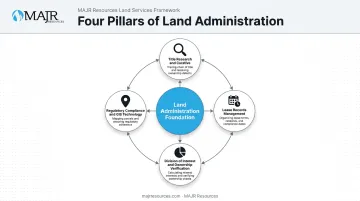
Title Research and Curative
Title research traces the chain of ownership back through courthouse and county records, sometimes to the original sovereign land grant. The goal is a clean, marketable title with no gaps, breaks, or unresolved claims.
When defects like a missing heir, an improperly recorded transfer, or an outstanding lien surface, curative work resolves them before drilling proceeds. This can mean:
- Drafting affidavits of heirship
- Filing certified probate documents
- Preparing ratification agreements
- Obtaining subordination agreements from lienholders
Oklahoma's title examination standards, for example, require an unbroken recorded chain of title for 30 years to establish marketable title. Standards like this exist state by state, which is part of why title curative work is so specialized.
Lease Records Management
Large lease portfolios come with dozens or hundreds of moving parts: primary terms, rental obligations, royalty schedules, and renewal deadlines. Teams tracking these across multiple counties or states need a system that flags upcoming deadlines before they're missed.
Miss a renewal date, and the consequence is blunt: lost acreage. Rights lapse, and the operator has to renegotiate from scratch, often at a worse position than before. Proactive tracking — not reactive scrambling — is what prevents this.
Division of Interest and Ownership Verification
Once a well starts producing, division orders confirm exactly who gets paid and how much. This step verifies royalty and working interest owners and calculates accurate revenue splits before the first check goes out.
Getting this wrong sends payments to the incorrect owner or in the wrong proportion, a problem that can trigger disputes, suspended proceeds, or audit headaches years later. Meticulous record-keeping here isn't optional; it's what protects an operator during any future compliance review.
Regulatory Compliance and GIS Technology
Federal and state agencies require approved permits before drilling can begin. The BLM, for instance, mandates a complete Application for Permit to Drill package that includes a drilling plan, surface use plan, and certified well plat before any surface-disturbing activity starts.
Alongside regulatory filings, modern land administration relies heavily on technology. GIS mapping has become essential for visualizing tract boundaries and ownership overlays, particularly on multi-regional acquisitions where dozens of tracts and owners overlap. It lets analysts see both surface boundaries and subsurface mineral intervals in one view, which speeds up due diligence considerably.
The Role of a Landman
A landman is the professional who negotiates leases, researches title, and manages relationships with mineral owners on behalf of an operator. The American Association of Professional Landmen describes the landman as the public-facing member of the E&P team — the person who sits across the table from a landowner and hammers out lease terms.
Field Landmen vs. Title and Division Order Specialists
The role has become specialized enough that few landmen carry a project from prospect stage all the way to first oil sale. Two distinct functions typically emerge:
| Role | Core Responsibilities |
|---|---|
| Field Landmen | Lease acquisition and negotiation, landowner relationships, preliminary title checks |
| Title & Division Order Specialists | Chain-of-title research, curative document drafting, mineral ownership reports, division order preparation |
These roles complement each other. Field work gets the lease signed; title and division order work makes sure that lease actually holds up once production starts.
A Typical Day
On any given day, a landman might run title at the courthouse in the morning, draft a lease agreement over lunch, and spend the afternoon coordinating with an attorney on a curative requirement. Strong landmen bring:
- Legal and contract knowledge
- Negotiation skill under pressure
- Familiarity with GIS and land records systems
- Patience for tracing decades-old inheritance chains
MAJR Resources has built its practice around this full spectrum of work. Since 2005, the Monahans, Texas-based firm has handled lease negotiation, mineral rights verification, and due diligence for energy companies across the Permian Basin.
The firm's projects also extend into North Dakota, Oklahoma, New Mexico, Louisiana, and several other states. That range matters, because every region carries its own title standards, courthouse quirks, and local regulatory wrinkles.
Why Land Administration Matters: Risk, ROI, and Efficiency
Three factors determine the return on an E&P investment: title quality, land management strength, and divestment readiness.
Skip proper title diligence upfront, and the costs show up later — usually at the worst possible time.
- Suspended royalty proceeds. Under Texas regulatory guidance, operators can suspend royalty payments without interest during a title dispute, freezing revenue until it resolves.
- Deal-killing defects. In an acquisition, defects caught during diligence become negotiable line items; defects caught after closing become lawsuits.
- Divestiture friction. Clean, well-organized land records speed up sales and reduce buyer objections, while messy records invite delays and price renegotiation at closing.
The pattern is consistent: proactive land administration keeps small issues small. Reactive land administration turns them into legal and financial liabilities. Bridging that gap early, before defects harden into disputes, is the core value of dedicated due diligence work like MAJR Resources provides for acquiring operators.
In-House vs. Outsourced Land Administration: Choosing the Right Approach
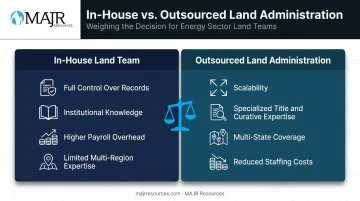
Building an internal land team gives you control and institutional knowledge: your staff knows your assets, your history, your relationships. But it comes with overhead, and few companies are staffed to handle every region's title standards and courthouse systems in-house.
Outsourcing trades some of that control for scalability and specialized expertise. It tends to make the most sense when:
- You're acquiring acreage across multiple states or basins at once
- Your company is growing faster than your land department can hire
- You need specialized title curative or heirship-tracing skills for a complex project
- Internal bandwidth is stretched thin during a drilling push
MAJR Resources built its model around this integrated approach, combining historical chain-of-title research, GIS technology, and legal compliance under one roof. Rather than treating title research and lease tracking as separate vendor relationships, the firm coordinates them as a single workflow.
That coordination cuts down on the back-and-forth that slows multi-party title reviews. For companies weighing whether to build internally or bring in outside expertise, comparing notes directly with a team like MAJR Resources can help clarify which model fits.
Frequently Asked Questions
What does oil and gas land management include?
It includes title research, lease record tracking, ownership verification, division order preparation, and regulatory compliance reporting. Together, these functions protect an operator's legal position and revenue accuracy from lease signing through production.
What does an oil and gas landman do?
A landman negotiates leases, researches title through courthouse and county records, and manages relationships with mineral owners on behalf of the operator. Many also coordinate curative work with attorneys to clear title before drilling.
What is the difference between land administration and land management?
Land administration focuses on records and data accuracy — clean title, current leases, correct ownership. Land management is broader, covering acquisition strategy and development coordination built on top of that administrative foundation.
Is it worth outsourcing land administration for a small or mid-sized operator?
Often, yes. Outsourcing reduces payroll overhead while giving you access to specialized title and curative expertise, especially if you don't have a dedicated land department on staff.
What happens if land administration is neglected?
Expect lost acreage from missed lease deadlines, royalty payments sent to the wrong owner, and legal disputes over ownership. These problems tend to surface at the worst possible time, usually right before drilling or during a sale.
Does land administration apply to renewable energy projects too?
Yes. Renewable energy developers rely on similar title review, lease negotiation, and ownership verification principles to secure long-term site control and avoid encumbrance disputes down the road.