Introduction
Every day, real estate closings, oil and gas leases, and renewable energy land deals stall for the same quiet reason: a title search turns up a "cloud" on the ownership record. Someone forgot to release a lien. A signature is missing. An heir was never accounted for.
This is more common than most buyers and developers realize. A 2024 curative work study by ALTA found that 36% of title files were classified as "difficult," requiring substantial nonroutine work before a policy could be issued.
Those files averaged 45.4 staff hours, more than double the 22 hours needed for a standard file. Resolving these defects demands structured, labor-intensive work that buyers and developers should plan for early.
As mineral and surface rights pass through more generations, this work only gets more complex. This guide breaks down what title curative services actually involve and how the process moves from discovery to a clean, insurable title.
Key Takeaways
- Title curative services fix defects (clouds), making property or mineral titles clear, marketable, and insurable
- The process follows four stages: defect discovery, investigation, legal correction, and verification
- Common defects include missing signatures, unreleased liens, boundary errors, and fragmented mineral rights
- Oil and gas, renewable energy, and real estate deals all need curative work before financing or closing
- Complex issues like quiet title actions or heir searches can extend timelines by months
What Are Title Curative Services?
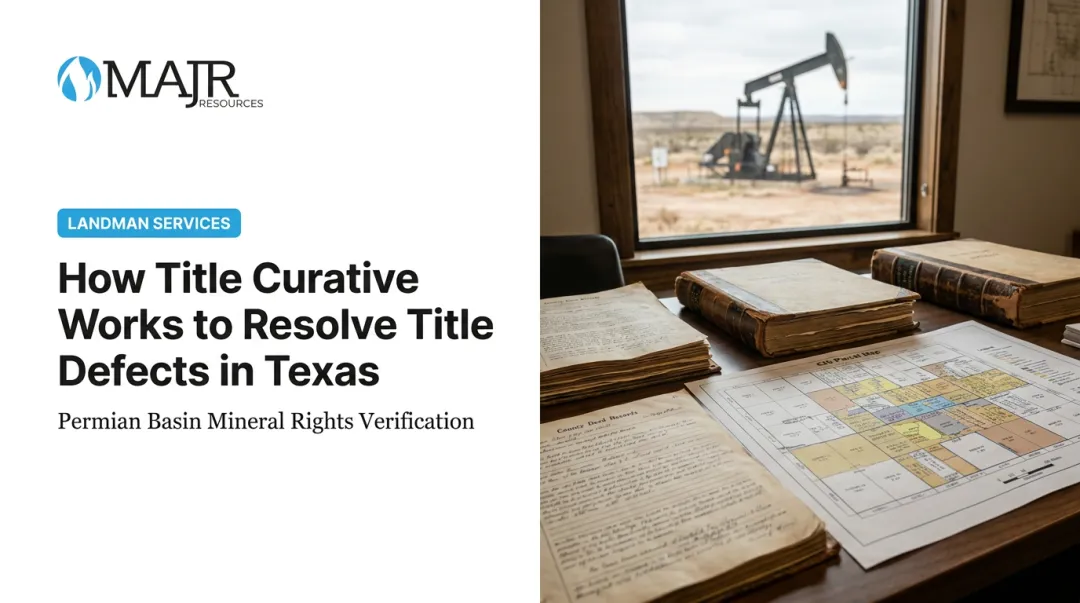
Title curative services identify and legally resolve defects, or "breaks," in a chain of title so ownership is clear, undisputed, and marketable.
When a title search uncovers an unreleased mortgage, a missing heir, or a clerical deed error, that defect blocks a title company from underwriting insurance and blocks a deal from closing. Curative work is the active correction step that removes those obstacles.
Not the Same as a Search or Insurance
It helps to separate three related but distinct functions:
| Function | What it does |
|---|---|
| Title search | Identifies risks and traces ownership through deeds, liens, and court records |
| Curative work | Actively resolves the defects the search uncovered |
| Title insurance | Protects against covered losses from risks that remain undiscovered |
ALTA describes title insurance protection as the layer that applies once search and curative work are already complete, not a substitute for either.
Why Technology Hasn't Replaced This Work
GIS mapping and digital county records help, but they don't fix decades-old handwritten deeds, informal family transfers, or incomplete probate files. The National Archives notes that many historical land records still exist only on paper or microfilm. Someone still has to read them, interpret them, and correct what's wrong.
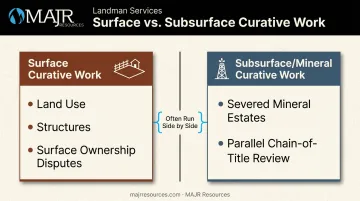
Curative work generally splits into two tracks:
- Surface title curative work — covers land use, structures, and surface ownership disputes
- Subsurface/mineral title curative work — covers severed mineral estates, which require their own parallel chain-of-title review
MAJR Resources' landmen handle title research that spans "surface to leasehold," reflecting how often these two tracks run side by side on the same project.
How Do Title Curative Services Work?
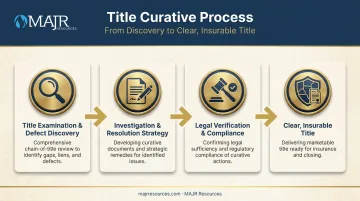
Curative work moves through four sequential stages. Skip one, or rush it, and the defect can resurface later, often at the worst possible moment in a transaction.
Initiation: Title Examination and Defect Discovery
The process typically starts when a title examiner or landman runs a historical records search and flags a cloud, such as an unresolved lien, a missing signature, or a mineral severance no one tracked.
This step is transaction-triggered. It happens because a lease, closing, or financing deal requires it, not as a continuous background task. Common bottlenecks here include:
- Incomplete or scattered county records
- Illegible or archaic handwriting on historical deeds
- Undiscovered or estranged heirs who never surface in standard record searches
MAJR's landmen work through county clerk offices, probate files, tax records, and GIS overlays to build the chain of title, since gaps at this stage tend to multiply downstream if missed.
Core Operation: Investigation and Resolution Strategy
Once a defect is flagged, curative specialists trace the ownership history and determine the specific fix required. This is where the real work happens.
Execution typically involves drafting and recording documents such as:
- Correction deeds for clerical or descriptive errors
- Affidavits of heirship for unresolved inheritance issues
- Quitclaim deeds to release a party's potential claim
Resolution speed depends on complexity. A clerical correction might take days, while locating a dozen dispersed heirs across three states can take months.
MAJR's landmen draft these curative instruments directly as part of their service, then coordinate with examining attorneys who apply state title standards and issue the formal title opinion.
Regulation/Control: Legal Verification and Compliance
Curative work stays on track through legal review. Title attorneys and underwriters verify that corrective documents meet state recording requirements and actually resolve the underlying defect, not just paper over it.
This stage runs on coordination: landmen, attorneys, title companies, and property or mineral owners all need to stay in sync on outstanding items and pending signatures.
Skipping this verification is risky. An improperly executed correction can resurface after closing, jeopardizing insurability or reopening a dispute nobody thought was settled.
Output/Result: Clear, Insurable Title
The end result is a clean, continuous chain of title that a title company is willing to underwrite. That's what unlocks everything downstream: lease execution, closing, financing approval, or the start of construction and production.
ALTA's research shows nearly all title companies perform curative actions on a given file, with 62% typically completing four or more per transaction. That volume of routine work is exactly why thorough, upfront curative review protects a project's timeline rather than derailing it later.
Common Title Defects and Curative Tools
Certain defects show up again and again in land and mineral transactions:
- Unreleased mortgages: a payoff was made but never formally released
- Boundary description errors: legal descriptions that don't match actual surveyed lines
- Undisclosed or estranged heirs: inherited interests no one formally documented
- Incomplete probate records: an estate that never cleared probate
- Severed mineral rights: subsurface interests separated from surface ownership generations ago, often through informal transfer
Each defect type calls for a specific tool:
| Defect | Typical curative tool |
|---|---|
| Clerical or descriptive error | Correction deed |
| Missing heir documentation | Affidavit of heirship |
| Potential competing claim | Quitclaim deed |
| Complex, unresolved chain issue | Curative title opinion |
| Contested ownership dispute | Quiet title action |
Complexity swings widely. A bank issuing a satisfaction of mortgage might take days, while a quiet title lawsuit involving multiple heirs across state lines can stretch into months.
ALTA's 2026 survey found that 58.7% of respondents typically remove three to five title requirements per transaction, and 20.8% remove six or more, a reminder that most files involve multiple fixes rather than one isolated document. Requirement volume directly shapes how long a deal takes to reach the closing table.
Where Title Curative Services Are Used
Curative work fits into a transaction at specific, predictable points:
- Pre-lease due diligence: before an operator or developer commits to a mineral or surface lease
- Acquisition and divestiture (A&D) reviews: when portfolios of interests change hands
- Financing and closing: when a lender or title underwriter requires a clean title before funding
- Immediately before construction or production: the final checkpoint before ground is broken
Certain conditions make curative work especially critical:
- Multi-generational, family-owned mineral estates with fragmented ownership
- Rural properties with incomplete or hard-to-access historical county records
- Multi-state or multi-regional land portfolios, where each jurisdiction follows different recording rules
A 2023 Housing Assistance Council and Fannie Mae study identified 491,537 residential properties as "at risk" for heirs' property status, with roughly two-thirds in rural census tracts. Rural mineral estates face similar fragmentation, since the same heirship gaps that cloud residential title also break mineral chains of title across generations.
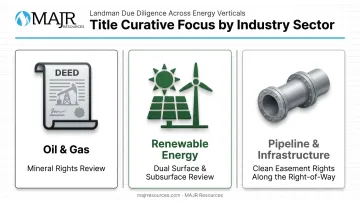
The approach differs by sector, too. Oil and gas leasing leans heavily on mineral rights review. Renewable energy development often requires dual surface and subsurface review, since solar and wind projects need clean site control on both. Pipeline and infrastructure projects, by contrast, typically focus on securing clean easement rights along a defined right-of-way.
Conclusion: Why Expert Curative Support Matters
Title curative work is a specialized, multi-stage process that depends on landman expertise, legal coordination, and patient historical research, especially when mineral estates or multi-state portfolios are involved.
Identifying potential defects early and bringing in a team that has actually done this work before changes outcomes. MAJR Resources has spent over 20 years handling landman and mineral rights work across Texas and multi-state oil, gas, and renewable energy projects. That experience means fewer surprises during curative review and a more confident path toward closing or production. For companies weighing a lease, acquisition, or development timeline, reaching out early tends to save far more time than it costs.
Frequently Asked Questions
What is a title cure?
A title cure is the legal correction of a defect or "cloud" found during a title search. It resolves issues like liens, clerical errors, or missing heirs so ownership can transfer clearly and legally.
What does curative mean in law?
In a legal context, curative refers to actions taken to fix or remedy a defect in a legal document or record, restoring its validity. Applied to titles, it means correcting the chain of ownership.
What are the four types of titles?
The commonly referenced deed types are general warranty, special warranty, quitclaim, and bargain-and-sale deeds. Each offers a different level of protection, which affects how much curative responsibility falls on the buyer versus the seller.
How long does title curative work take?
Timing ranges from a few days for simple clerical fixes to several months for complex issues like missing heirs or quiet title actions. Difficult files can require over 45 staff hours alone, according to ALTA data.
Who performs title curative work?
A team typically handles it together: landmen research the chain of title and draft curative documents, while title examiners and real estate or oil and gas attorneys review, validate, and issue formal opinions.
Is title curative the same as title insurance?
No. Curative work resolves existing defects before closing. Title insurance protects against future or undiscovered risks once the title has already been cleared.