Introduction
A title examination comes back with a problem: a missing heir, an unreleased lien, a deed that never made it to the courthouse. This is where title curative work begins, and it happens on nearly every lease, acquisition, and drilling project across Texas.
Texas produced more than 40% of all US crude oil in 2024, and the Permian Basin alone supplied 48% of that national total. With that much activity concentrated in one region, mineral title work carries real weight.
Many non-landmen assume a "clean" title search means the deal is done. It doesn't. Curative work is the step that fixes what the examination found, and misunderstanding it leads to stalled drilling permits, missed lease deadlines, and expensive delays.
This guide breaks down exactly how title curative work moves from defect to resolution in Texas energy transactions.
TL;DR
- Curative work resolves liens, missing heirs, and unrecorded documents to clear mineral title
- The process moves through four stages: identify, research, draft, and finalize
- Common Texas defects include unprobated estates and community property claims
- Fast, accurate curative work keeps leasing and drilling timelines on track
- Landmen and title attorneys typically manage this cycle together for energy clients
What Is Title Curative Work?
Title curative work is the process of correcting defects a title examination uncovers so a mineral or land interest becomes legally marketable and, in industry terms, "drillable." It follows the title examination, correcting what that diagnostic step uncovers.
Operators and investors won't commit capital without ownership certainty. An unresolved defect, like a forged signature or a missing probate record, creates real legal and financial exposure. Curative work removes that risk before money or rigs move.
Curative Work vs. Title Search vs. Title Insurance
These three get confused constantly, so here's the distinction:
| Function | What It Does | What It Doesn't Do |
|---|---|---|
| Title search/examination | Identifies ownership, defects, and encumbrances | Doesn't fix anything |
| Title insurance underwriting | May insure around a risk with a policy exclusion | Isn't a determination of actual mineral ownership |
| Title curative work | Corrects or clears the defect itself | N/A |
Insurance is not a substitute for curative work. Mineral rights are frequently excluded from title policies altogether, or only partially covered. When there's no full policy backing the mineral interest, direct resolution of the defect is the only real safeguard an operator has.
Two Paths: Administrative vs. Litigation Curative
Curative work generally splits into two categories, and the timeline difference between them is significant:
- Administrative curative: corrective deeds, affidavits, ratifications, subordination agreements. This path depends on cooperative parties and available evidence, and can often move in days or weeks.
- Litigation curative: quiet title actions or trespass-to-try-title suits. This path applies when ownership is genuinely disputed and a party won't cooperate, adding pleadings, service, proof, and possibly a trial.
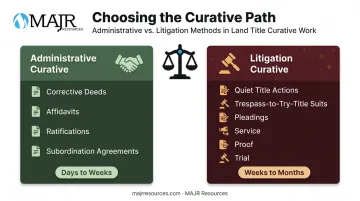
Most Texas curative projects stay on the administrative track. Litigation becomes necessary only when negotiation fails.
How Does Title Curative Work?
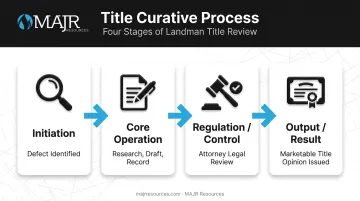
Curative work follows a defined sequence, from the moment a defect surfaces to the moment a clean opinion gets issued. Each stage builds toward one outcome: a marketable title.
Initiation
The process starts when a title examination or an attorney's title opinion flags specific "requirements" that must be cured before a lease, drilling permit, or acquisition can move forward.
This stage is still primarily a manual effort. A landman or examining attorney reviews the abstract line by line, though GIS mapping and record-search tools increasingly help surface common defect patterns, such as overlapping ownership claims or gaps in the recorded chain of title.
Common bottlenecks at this point include:
- Locating heirs who may not know they hold an interest
- Obtaining historical probate or tax records from county archives
- Waiting on slow county clerk record requests
Core Operation
Once the defect is identified, the landman determines exactly what's needed to fix it, whether that's a missing lien release, a defective conveyance, or an unresolved heirship, and starts drafting or sourcing the right instrument.
This is where the actual work happens:
- Research probate files, tax rolls, and historical deed records
- Draft the appropriate instrument (affidavit of heirship, ratification, corrective deed, subordination agreement)
- Obtain signatures and notarization from all required parties
- Record the instrument with the county clerk
Speed and accuracy here directly affect real deadlines. Bonus payments frequently depend on completed title verification. Drilling permits can't move until the drillsite title opinion clears. Division order title opinions can't finalize until ownership is settled. A slow or sloppy curative process delays all three.
Regulation / Control
Before any curative document counts as resolving a defect, the examining attorney reviews it for legal sufficiency. This isn't a rubber stamp.
The attorney cross-references each new instrument against Texas Property Code requirements — including the state's separate rules for nonmaterial versus material correction instruments — and applicable title examination standards.
This control step matters because it:
- Prevents future title claims from resurfacing
- Protects the operator from drilling on a defective title
- Avoids costly litigation that could have been caught earlier
Output / Result
The end product is a supplemental or division order title opinion confirming the interest is marketable and drillable. That opinion is what unlocks the next step, whether that's finalizing a lease, clearing a Railroad Commission drilling permit, or closing a mineral acquisition.
Higher-quality curative work means fewer legal disputes and a shorter path to production. That's why experienced landman teams, including MAJR Resources, manage the entire curative cycle for E&P and renewable energy clients across Texas.
Common Title Defects That Require Curative Work in Texas
Certain defects show up again and again in Texas mineral and land title examinations:
- Unreleased liens or mortgages — old encumbrances that were never formally discharged of record
- Missing heirs or unprobated estates — a deceased owner's interest never passed through a documented probate process
- Forged or improperly executed deeds — defective acknowledgments or signatures that undermine the conveyance
- Unrecorded conveyances or leases — documents that exist but were never filed with the county clerk
The Missing Heir Scenario
This is one of the most common Texas curative issues. When an heir surfaces claiming an interest, the fix typically follows one of three paths:
- An affidavit of heirship establishing the heir's claim when there's no dispute
- A negotiated quitclaim or ratification from the heir confirming or releasing their interest
- A quiet title action if the heir won't cooperate or the ownership is contested
This scenario is becoming more common industry-wide. The AAPL has noted that a shrinking pool of experienced field landmen raises the risk of missed or increased title defects, particularly as legacy tracts continue changing hands.
Community Property and Mineral-Specific Issues
Texas is a community property state, which means a spouse's unaddressed interest in a mineral conveyance can cloud the title even when only one name appears on the deed. Curative work must confirm whether the interest was community or separate property before the conveyance is treated as clean.
Other mineral-specific defects include:
- Confusion between severed mineral and surface ownership
- Expired or lapsed leases still sitting in the chain of title
- Gaps in Railroad Commission compliance tied to the drillsite
Where Title Curative Work Fits in Texas Energy Transactions
Curative work doesn't happen at one single point. It shows up throughout the transaction lifecycle:
| Stage | Curative Role |
|---|---|
| Pre-lease due diligence | Identifying ownership gaps before executing a lease |
| Post-lease title opinion review | Resolving requirements flagged in the drillsite title opinion |
| Division order preparation | Correcting interest allocations before revenue distribution |
| Pre-drilling permit clearance | Clearing final defects before the rig moves |
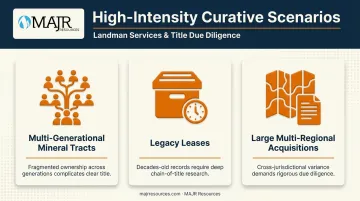
Curative work gets most intensive in three scenarios:
- Multi-generational mineral tracts, where fragmented heirship makes every transfer a research project
- Legacy leases with decades-old records, requiring sovereign title searches and interpretation of outdated lease language
- Large multi-regional acquisitions, where jurisdictional variation and document volume add complexity even when individual tracts aren't complicated
The same underlying principles extend beyond oil and gas. Solar developers in Texas often need comparable title clearance for surface use agreements, since a severed mineral estate can retain dominant surface rights that affect where panels can go.
Conclusion
Title curative work follows a clear sequence: examination, curative action, legal review, and a final opinion, each stage depending on the one before it.
Energy companies that run this process efficiently avoid the downtime that eats into lease bonuses, permit timelines, and closing dates. That efficiency protects the underlying investment, well beyond the paperwork trail.
If you need Texas mineral or land title curative support, reach out to MAJR Resources for full-title landman services built around exactly this process.
Frequently Asked Questions
How much does it cost to correct a deed?
Costs vary widely based on defect complexity. A simple corrective deed involves modest attorney and recording fees, while contested issues requiring a quiet title action can cost far more due to added legal proceedings.
How do you cure a defect in title to real property?
Common methods include corrective instruments, affidavits of heirship or facts, and negotiated releases from the affected party. When cooperation fails, a quiet title or declaratory judgment action becomes necessary.
What does curing title mean?
Curing title means resolving any issue, such as a lien, missing heir, or unrecorded document, that clouds legal ownership. Once resolved, the property or mineral interest becomes marketable and transferable.
When a missing heir is claiming an interest in property, how is this title defect cured?
This is typically resolved through an affidavit of heirship, a negotiated quitclaim or ratification from the heir, or a quiet title lawsuit if the heir disputes the claim or won't cooperate.
How long does title curative work take on a Texas oil and gas property?
Timelines range from a few days for straightforward administrative fixes, like a corrective deed, to several months when litigation such as a quiet title action becomes necessary.
Who performs title curative work in Texas oil and gas transactions?
Landmen and title attorneys typically collaborate on this work. MAJR Resources manages the research, document preparation, and negotiation on behalf of E&P clients, while the examining attorney handles final legal sufficiency review.