
Introduction
Picture this: a pipeline company spends months negotiating a right-of-way across a ranch in West Texas. The landowner signs, the easement gets recorded, construction begins. Then the landowner defaults on a mortgage that predates the easement by five years. The bank forecloses — and the pipeline's right-of-way disappears with it.
This isn't a hypothetical. Under longstanding real property law, foreclosure on a prior mortgage extinguishes any later-recorded easement the lender never agreed to protect, wiping out infrastructure investments in the process.
Without a properly executed consent, non-disturbance, or subordination agreement, an easement recorded on already-mortgaged land can be legally erased in foreclosure. That risk threatens project timelines, financing, and years of negotiation work.
This guide breaks down what these agreements actually do, why they matter for oil & gas and renewable energy land transactions, and how to secure them before they become a problem.
Key Takeaways
- Subordination agreements reorder lien priority, letting easements survive foreclosure; consent alone doesn't
- The "first in time, first in right" rule lets older mortgages outrank newer easements unless lenders agree otherwise
- Consent, non-disturbance, and subordination provide three distinct protection levels; choosing the wrong one risks project exposure
- Experienced landmen catch lien issues early, before they turn into six-figure delays
What Is a Subordination Agreement and Consent to Easement?
A subordination agreement is a legal document in which a lienholder, typically a mortgage lender, agrees to place the easement holder's rights ahead of its own lien. In plain terms, the bank steps back in line so the pipeline, utility corridor, or access road takes priority.
A consent to easement is different and narrower. It's simply the lender's agreement allowing an easement to be recorded without triggering a technical default under a loan covenant that restricts further encumbrances on the property. Consent gets the paperwork filed; it doesn't guarantee the easement survives if the bank later forecloses.
The "First in Time, First in Right" Problem
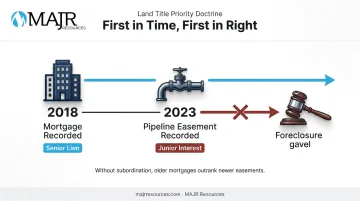
Property law generally follows a simple rule: whichever interest gets recorded first wins. According to WeConservePA's guide on pre-existing mortgages, a mortgage recorded before an easement is ordinarily senior, meaning the later easement is subject to that mortgage and can be eliminated through foreclosure.
That's the trap. If a landowner mortgaged the property in 2018 and grants a pipeline easement in 2023, the 2018 mortgage generally outranks the easement automatically, unless the lender signs an agreement changing that outcome.
This shows up constantly in real transactions:
- Pipeline right-of-way grants across mortgaged ranchland
- Utility corridor easements for transmission lines
- Mineral lease development on financed acreage
- Solar and wind installation easements on farmland with existing loans
Why These Terms Get Confused
Consent, non-disturbance, and subordination often appear bundled into a single document, sometimes even called a "Consent, Non-Disturbance, and Subordination Agreement." That naming convention causes confusion. Signing a consent form doesn't mean the easement is protected from foreclosure. Only subordination changes lien priority; consent and non-disturbance work differently, which we'll unpack below.
Why Subordination Agreements Matter: Risks of Unaddressed Prior Liens
Skipping this step threatens the very asset an energy company just spent months securing.
A Documented Case of What Goes Wrong
In Helmboldt v. Jugan (Tenn. Ct. App. 2016), a landowner recorded a deed of trust with a lender in 2006, then recorded a buffer easement in 2010. The lender never joined the easement agreement, never subordinated its position, and reportedly didn't even know the easement existed.
When the loan defaulted and the property went to foreclosure in 2012, the Tennessee Court of Appeals held that the easement was extinguished by operation of law.
The court's reasoning was straightforward: a purchaser at a foreclosure sale takes title free of any encumbrance created after the mortgage was recorded. No subordination, no protection: the easement simply vanished.
Beyond Foreclosure: Financing and Insurance Bottlenecks
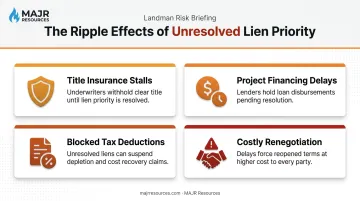
Unresolved lien priority creates ripple effects long before any default happens:
- Title insurers won't clear title until lien priority against the easement is documented
- Project financing stalls when lenders on the energy company's side can't confirm the right-of-way is insurable
- Tax-deduction donations require it: Treasury Regulation 1.170A-14(g)(2) blocks deductions unless the mortgagee subordinates its rights to the conservation purpose
- Renegotiation gets expensive once construction has started and the gap gets discovered mid-project
For companies operating across multiple states (Texas, New Mexico, Oklahoma, North Dakota), this problem compounds. Each jurisdiction handles foreclosure and lien priority slightly differently, and records aren't always complete or easy to trace. The fix is proactive: identify every lienholder on the servient property before drilling, pipeline construction, or renewable installation begins, not after.
Breaking Down the Three Key Provisions
Not every transaction needs all three protections. Understanding what each one actually does prevents signing the wrong document and assuming you're covered.
| Provision | What It Does | Changes Lien Priority? |
|---|---|---|
| Consent | Authorizes recording the easement without violating loan covenants | No |
| Non-Disturbance | Lets the easement survive foreclosure without reordering priority | No |
| Subordination | Places the easement ahead of the mortgage in priority | Yes |
Consent
Consent solves one narrow problem: many mortgages contain a no-further-encumbrance clause, meaning the borrower can't add new easements without lender approval. Consent is the lender saying "go ahead and record it." That's it. It doesn't promise anything about what happens if the loan defaults later.
Non-Disturbance
A non-disturbance agreement is the most commonly requested protection for pipeline, utility, and trail easements. The lender agrees that if it forecloses, the buyer takes the property subject to the easement — the right-of-way survives. This doesn't touch lien priority. The mortgage stays senior on paper; the easement just gets a contractual carve-out protecting it from extinguishment.
Subordination
Full subordination goes further: it reorders priority so the easement holder's rights sit ahead of the mortgage. This becomes mandatory in specific situations:
- Conservation easement donations claiming a federal tax deduction
- Title insurance requirements that won't issue a clean policy otherwise
- Grant or incentive program conditions tied to renewable energy financing
Non-disturbance is generally easier to obtain because it feels less threatening to a lender: the mortgage stays senior, just with an exception carved out. Subordination asks the lender to accept a much lower position. That's a harder sell, especially once the mortgage has been securitized and sold into a pool the original lender no longer controls.

Who Prepares the Agreement and Who Are the Dominant and Servient Owners?
Simplify Easement Agreements with Expert Landman Services
Request a quote and our experts will contact you within 24 hours with tailored solutions and pricing.
For immediate assistance, feel free to give us a direct call at (432) 251-5156. You can also send us a quick email at info@majrresources.com.
For immediate assistance, feel free to give us a direct call at (432) 251-5156. You can also send us a quick email at info@majrresources.com.