Introduction
Oil and gas title examination is the legal and factual process of verifying who actually owns the rights to explore, drill, and produce oil and gas on a specific tract of land. Before a single dollar goes toward leasing or drilling, someone has to answer that question with certainty.
This explanation is built for landowners, mineral owners, exploration and production (E&P) companies, and industry newcomers alike. Title certainty determines whether a lease is enforceable, whether a well can legally be drilled, and who gets paid once production starts.
"Title work" gets thrown around constantly in oil and gas conversations, yet it's rarely broken down at an operational level. This article covers what it is, why it matters, how the process actually runs, and when it applies during a project's lifecycle.
Key Takeaways
- Title examination confirms legal ownership before committing capital to leasing or drilling
- Title work yields three opinion types: preliminary/drilling, division order, or supplemental
- Landmen, abstractors, and title attorneys each play a distinct, coordinated role
- Skipping or rushing title work often causes legal disputes and stalled projects
- Recording quality, mineral severances, and state-specific standards shape timeline and complexity
What Is Oil and Gas Title Examination?
Title examination is the legal review of public land records to determine current, valid ownership of mineral and surface rights tied to a specific tract. It's designed to produce one thing: a documented, defensible answer to "who owns this, and can we legally lease or drill it?"
Examination vs. opinion: these terms aren't interchangeable. The examination is the research process — pulling deeds, tracing conveyances, reviewing probate files. The title opinion is the attorney's legal conclusion drawn from that research, applying legal judgment to what the examination uncovers.
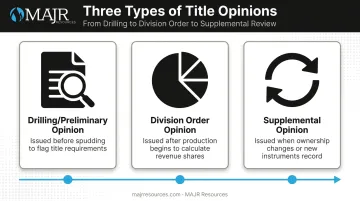
The Three Core Types of Title Opinions
Depending on where a project sits in its lifecycle, examination produces different deliverables:
- Drilling title opinion (sometimes called preliminary): Confirms title before a well is spudded and flags requirements that need clearing first
- Division order title opinion: Prepared after production begins, calculating each party's decimal share of revenue
- Supplemental title opinion: Updates an earlier opinion when ownership changes, new instruments record, or curative work gets completed
Examination gets triggered at four distinct points: before leasing, before spudding a well, after first production, and during acquisitions or financing.
Title Opinion vs. Title Insurance
These are not the same product. A title opinion is an attorney's professional legal analysis based on specific records and stated assumptions, not a guarantee. Title insurance, by contrast, is a contract that shifts certain covered risks to an insurer. Oil and gas transactions rely primarily on attorney opinions, not insurance policies, because mineral title carries complexities that standard title insurance often doesn't cover well.
Why Title Examination Is Essential in Oil & Gas Operations
Operators don't order title examination out of caution alone. It serves three concrete purposes:
- Confirms legal right to drill before capital gets committed to a rig
- Protects against ownership disputes that can freeze production or trigger litigation
- Ensures accurate royalty distribution once revenue starts flowing
What happens without it? Wells get drilled on defective title, and royalty checks go to the wrong parties. Ownership disputes end up in court, stalling projects mid-development while attorneys sort out who actually holds what interest.
One documented example: in Vic Christensen Mineral Trust v. Enerplus Resources, a defect first flagged in the operator's drilling title opinion led to competing ownership claims, suspended royalty payments, and litigation that dragged on for years. That's what an unresolved defect can turn into.
It's Often a Lender Requirement, Not Just Best Practice
This isn't optional due diligence in many financing scenarios. OCC supervisory guidance for banks states that when a loan is secured primarily by oil-and-gas reserves, the bank should obtain a title opinion prepared by a competent oil-and-gas attorney.
Lenders have also negotiated title coverage tests representing 60% to 90% of the value of properties on the reserve report, according to Texas A&M Law Review research on E&P lending practices.
This is exactly where full-service landman and title research partners earn their keep. MAJR Resources handles the research and negotiation legwork for E&P companies: chain of title construction, ownership verification, and curative document preparation.
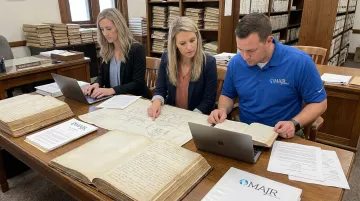
This lets operators stay focused on operations instead of chasing courthouse records, while minimizing the downtime that unresolved title issues tend to cause.
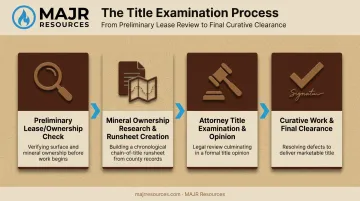
How the Title Examination Process Works (Step-by-Step)
The process runs from initial records research to a final legal opinion, and sometimes further into curative resolution. Along the way, it draws on:
- County deed records
- Probate files
- Tax records
- Prior leases and mineral conveyances
A licensed title attorney verifies ownership percentages and legal names against these documents, applying state-specific title standards. The end result: a documented opinion that either clears the path forward or lists exactly what needs fixing first.
Step 1: Preliminary Lease or Ownership Check
A landman runs a quick lease check to confirm nothing blocks the deal before deeper research starts. This means verifying whether the land is available, part of a pooled unit, or held by production from an existing well nearby.
It's a cursory review, often taking just a few hours, using sources like the state's oil and gas regulatory database and third-party production data services. The goal: avoid spending money on deep research for land that's already off the table.
Step 2: Mineral Ownership Research and Runsheet Creation
If the lease check clears, the landman traces the chain of title back through historical records, building a runsheet that documents every relevant conveyance, probate filing, and prior lease. GIS technology often supports this step by overlaying property boundaries, geological maps, and existing lease data, helping identify gaps or overlapping claims that pure document review might miss.
Step 3: Attorney Title Examination and Opinion
The compiled runsheet and supporting documents go to a title attorney, who applies the applicable state title standards to check for flaws. A thorough, well-organized runsheet tends to speed up this step considerably. If defects surface, the attorney issues curative requirements before approving the opinion.
Step 4: Curative Work and Final Clearance
The landman resolves outstanding requirements (affidavits of heirship, corrective instruments, ratification agreements, locating missing heirs) so the title clears for drilling or division order preparation. If curative items can't be fully resolved, the project either waits, waives the requirement, or gets abandoned.
Key Factors That Affect Title Examination Outcomes
Several variables determine how long and complex examination becomes:
- County recording quality — Incomplete or handwritten historical records slow research and raise the odds of missed defects
- Mineral vs. surface severance history — Severed subsurface rights require separate historical tracing from surface ownership
- Jurisdiction-specific standards — Texas Title Examination Standards, for instance, define what qualifies as marketable title in that state, and standards vary elsewhere
- Ownership complexity — Heirship, probate proceedings, and multiple co-owners extend both research time and curative work
- Project scale — A single lease check differs enormously from a multi-tract or multi-regional acquisition requiring broader legal review
These factors compound. A multi-tract acquisition with severed minerals and thin county records in a strict-standards jurisdiction can take several months, versus a week or two for a clean single-lease check. MAJR Resources applies GIS-based research and jurisdiction-specific expertise to move through these complications efficiently and keep projects on schedule.
Common Issues, Misconceptions, and Limitations of Title Examination
A few misunderstandings show up repeatedly, and they're worth correcting directly.
"A preliminary title opinion is enough to drill." It's not. A preliminary or drilling opinion is only an initial overview with stated requirements, not a certified clearance, and those requirements need resolution before drilling can proceed.
"Title opinion and title insurance are the same thing." They aren't. A title opinion is a legal conclusion issued only by a licensed attorney, while title insurance is a financial protection product from an insurer. Confusing the two can leave real gaps in coverage.
"Clean surface title means clean mineral title." Not necessarily — severed minerals require their own historical tracing, completely separate from surface ownership records.
Title examination also isn't a one-time event; it typically needs repeating or supplementing when:
- Ownership changes hands
- A new lease gets executed
- Significant time has passed since the last opinion, and new instruments have likely been recorded since
Having "a title opinion on file" doesn't protect an investment by itself; what protects it is applying the process correctly and keeping it current as circumstances change.
Frequently Asked Questions
What is the difference between a title opinion and a title examination?
Title examination is the research process, meaning reviewing records and building the chain of title. A title opinion is the attorney's formal legal conclusion based on that research.
Who performs oil and gas title examination?
Landmen and abstractors handle the underlying research and compile runsheets, while only licensed attorneys issue the final title opinion. MAJR Resources provides that landman-side research and negotiation support.
What is a division order title opinion?
It's the opinion prepared after a well is drilled and proven productive, determining each party's decimal ownership percentage for allocating production revenue.
How long does an oil and gas title examination typically take?
Timelines vary widely based on ownership complexity and record quality. A basic lease check might take a few hours, while complex or multi-tract properties can require several weeks of research.
What happens when a title defect is found during examination?
The attorney issues curative requirements, and the landman works to resolve them through affidavits, corrective deeds, or locating missing heirs before the project moves forward.
Do mineral owners need a title examination before leasing their land?
Operators typically initiate the examination, but owners benefit from understanding the process since it verifies their legal ownership share and helps prevent future payment disputes.