Introduction
A single oil and gas operation touches dozens of asset types: drilling rigs, miles of pipeline, storage tanks, mineral leases, and land titles that stretch back generations. Managing all of it well is the difference between a smooth production timeline and a costly standoff.
The stakes are steep. Unplanned outages cost the typical business close to $125,000 per hour, according to ABB's 2023 Value of Reliability survey. For offshore platforms, some industry benchmarks put that figure even higher. Aging infrastructure and overlooked title risks only add to the exposure.
This guide breaks down what oil and gas asset management means, introduces the "5 P's" framework, and walks through proven strategies for reducing risk. It also covers a dimension operators often underestimate: land and mineral asset risk.
Key Takeaways
- Asset management spans physical, digital, human, and land/mineral assets across the full lifecycle
- Predictive maintenance and condition-based monitoring cut downtime and lower maintenance spend
- The "5 P's" framework gives operators a holistic maturity check
- Title defects and ownership disputes halt production as effectively as mechanical failure
- Landman and title specialists strengthen the land-asset pillar that many strategies ignore
What Is Oil and Gas Asset Management?
Oil and gas asset management is the systematic approach to maximizing asset value across exploration, production, refining, and distribution. It's a definition worth sitting with, because it captures both hardware and paperwork.
As the IFS asset management glossary puts it, effective management incorporates the processes and technologies needed to enhance operational efficiency throughout an asset's lifecycle. That requires engineers, asset managers, IT specialists, finance teams, and land/title experts working from the same playbook.
Types of Assets in Oil and Gas
Most operators think in terms of hardware, but the full picture includes four distinct categories:
- Physical assets — rigs, pipelines, refineries, and tanks that demand constant safety and compliance oversight
- Digital assets — software, IoT sensors, and analytics platforms that give operations teams real-time visibility
- Human assets — the skilled field crews and management teams whose training directly affects asset performance
- Land and mineral assets — leases, mineral rights, and title records, an asset class that gets far less attention despite its ability to halt a project just as fast as a mechanical failure
That last category is easy to overlook until a lease lapses or a title dispute surfaces mid-project. We'll come back to it.
The 5 P's of Oil and Gas Asset Management
Asset management standards like ISO 55000 push operators toward a structured maturity model. In practice, many operators distill this into five pillars, commonly referred to as the "5 P's":
- People — field crews, engineers, and landmen managing title and lease compliance
- Process — documented workflows for maintenance, procurement, and title curative work
- Physical Assets — the rigs, pipelines, and facilities themselves
- Performance — metrics tracking uptime, cost, and production output
- Plant/Policy — the governance structures and regulatory frameworks that keep everything compliant
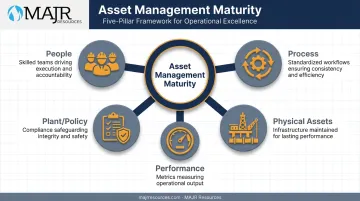
For an oil and gas operator, "People" isn't just roughnecks and technicians. It includes the landmen tracking lease deadlines and resolving title gaps before they become production stoppers.
Key Strategies to Optimize Oil and Gas Asset Management
High-performing operators combine proactive technology, lifecycle thinking, and land/title diligence. Reactive operators wait for something to break, then scramble. Here's what separates the two.
Predictive Maintenance and Advanced Analytics
IoT sensors paired with AI-driven analytics can forecast equipment failures before they happen, rather than after a technician notices a problem. Real-world case summaries from iFactory's oil and gas predictive maintenance research show reductions in unplanned downtime as high as 72%, with maintenance costs dropping by 38% in some deployments.
Major operators have piloted similar sensor networks on critical equipment, with heat-exchanger monitoring programs flagging issues well before failure in several deployments.
Condition-Based Monitoring (CBM)
CBM tracks vibration, temperature, and pressure in real time, flagging anomalies before they escalate into failures. This matters most for assets spread across wide geographies:
- Offshore platforms where physical inspection is expensive and infrequent
- Pipeline networks running hundreds of miles through remote terrain
- Remote wellheads without permanent on-site staff
Unlike scheduled inspections, CBM catches developing problems between visits.
Full Asset Lifecycle Management
Lifecycle management follows an asset from design and procurement through decommissioning, not just its operating years. Gulf of Mexico operators have run life-extension programs on platforms well beyond original design specifications, using inspection and integrity programs covering hulls, moorings, and risers to justify extended service life under regulatory oversight.
Treating an asset's entire lifecycle as one continuous decision, rather than a series of disconnected phases, tends to surface cost savings that a narrower maintenance view misses.
Systems Integration (EAM/CMMS with ERP and Land Systems)
Maintenance systems, finance platforms, and land/lease databases too often operate as separate silos. Predictive maintenance pilots that lack integrated maintenance history have reported false-positive rates as high as 60% in some analyses.
Once those systems are connected, and CMMS work-order history is linked to live monitoring data, false positives can drop below 12%, giving teams earlier and more reliable warnings.
The lesson applies beyond maintenance data. Land and lease records that live outside the core operational system create the same blind spots, just in a different department.
Regular Inspections and Risk-Based Audits
Automated monitoring is not foolproof. Scheduled inspections and risk-based audits catch what sensors sometimes miss.
The 2015 Plains Pipeline Line 901 rupture is a sobering example. A PHMSA failure investigation found the cause to be external corrosion that thinned the pipe wall, worsened by ineffective coating and cathodic protection. Routine, well-executed inspection protocols are designed to catch exactly this kind of degradation before it becomes a rupture.
Proactive Land and Mineral Title Management
Not every delay traces back to steel and sensors. Many project stoppages come from unclear mineral ownership, a lapsed lease, or a title defect nobody caught in time.
Common culprits include:
- Missed lease renewal deadlines in fast-moving lease markets
- Gaps or clerical errors in the chain of title
- Undisclosed heirs or retained mineral rights that surface years later
- Overlapping or competing ownership claims
Rigorous title research and skilled negotiation when disputes arise are the specialty of landman firms like MAJR Resources. That work prevents exactly the kind of interruption that no amount of predictive sensor data can catch.
Benefits and Challenges of Effective Asset Management
Key Benefits
Getting asset management right pays off across the business, not just on the maintenance ledger:
- Cost reduction through optimized resource allocation and lower unplanned maintenance spend
- Enhanced safety and compliance via consistent monitoring and audit-ready documentation
- Better decision-making from integrated, real-time data spanning operations and finance
Common Challenges
Even well-run operators run into friction points:
- Aging infrastructure and legacy systems that resist modernization without significant capital investment
- Data silos between maintenance, finance, and land/title departments that slow response times
- Land and mineral rights complexities, including disputed ownership or expired leases, that stall projects independent of equipment condition
- Regulatory reporting demands across multiple states that add administrative overhead
Land and mineral rights complexities call for the same rigorous due diligence MAJR Resources provides, exactly the land-asset pillar covered next.
How MAJR Resources Strengthens the Land and Mineral Asset Pillar
MAJR Resources has served oil and gas clients since 2005, providing full-service landman and mineral rights support across Texas and increasingly for renewable energy projects nationwide. The company built its foundation on exactly the kind of due diligence that keeps title risk from becoming production risk.
Core services include:
- Chain of title research: tracing ownership back through deeds, wills, probate filings, and courthouse records
- Mineral rights ownership verification: confirming who actually holds rights before a lease is signed
- Lease negotiation and compliance monitoring: tracking renewal deadlines, royalty terms, and drilling obligations
MAJR's process moves from initial property research through chain-of-title construction, defect identification, and curative resolution (drafting quitclaim deeds, coordinating probate research, preparing pooling agreements). The output is a title abstract and title opinion that gives operators a legally sound foundation before drilling begins.
That due-diligence layer is what protects the land/mineral asset class within a broader asset management strategy. By clearing title obstacles proactively, MAJR helps minimize costly downtime and gives investors more confidence in the ownership behind a project. Operations teams can then stay focused on production instead of paperwork disputes.

Frequently Asked Questions
What is asset management in oil and gas?
It's the coordinated oversight of physical, digital, human, and land/mineral assets across their full lifecycle. The goal is maximizing value while minimizing risk and downtime.
What are the 5 P's of asset management?
People, Process, Physical Assets, Performance, and Plant/Policy. Together they provide a practical framework for gauging how mature an operator's asset strategy really is.
What is asset integrity management in oil and gas?
Asset integrity management is the discipline that keeps assets functioning safely throughout their lifecycle, covering corrosion control and structural monitoring. Standards like API 580 and 581 guide risk-based inspection practices.
What are the main types of assets in oil and gas asset management?
Physical assets (rigs, pipelines, tanks), digital assets (sensors, software), human assets (skilled workforce), and land/mineral assets (leases, titles, mineral rights).
How does predictive maintenance improve oil and gas asset management?
Real-time sensor data combined with AI analytics flags equipment issues before failure occurs. Some case studies report downtime reductions of up to 70% after adoption, though results vary by operation.
Why does land and mineral rights management matter in oil and gas asset management?
Title defects or ownership disputes can halt production as severely as an equipment breakdown. Verifying title before drilling begins is an essential, if often overlooked, asset management function.