Outsourcing often gets framed as a cost play — a line item to trim. But the real payoff shows up somewhere else entirely: faster lease turnaround, fewer title disputes, and less time spent putting out administrative fires instead of running the business.
This article looks at why oil and gas outsourcing, particularly landman and mineral title services, matters in practice. Not what it claims to save on a spreadsheet, but what it actually changes day to day.
Key Takeaways
- Outsourcing title work frees internal teams to focus on drilling and production decisions
- Proactive title clearance catches ownership problems before they delay a spud date
- Specialized partners turn fixed administrative overhead into variable, activity-based cost
- Skipping outsourcing often means inconsistent results and scaling headaches as volume grows
What Is Oil and Gas Outsourcing?
Oil and gas outsourcing means contracting specialized third-party providers to handle land, title, leasing, accounting, or compliance work instead of building that capability internally.
In the upstream world, this usually covers:
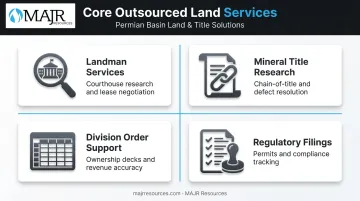
- Landman services — courthouse research, ownership verification, and lease negotiation
- Mineral title research — chain-of-title construction and defect resolution
- Division order support — ownership decks and revenue distribution accuracy
- Regulatory filings — permits, compliance tracking, and reporting
Outsourcing serves an operational goal: a faster, cleaner path to production with fewer interruptions. MAJR Resources has built two decades of practice around that exact handoff since 2005. The company takes on land and title work so E&P teams can stay focused on operations rather than courthouse records.
Key Advantages of Oil and Gas Outsourcing
The advantages below focus on measurable, operational impact rather than abstract promises. Each one ties directly to metrics operators already track: time-to-production, cost per acquisition, risk exposure, and team capacity.
Frees Internal Teams to Focus on Core Operations
Land and title work is specialized and time-intensive. When it sits with internal geologists, engineers, or operations staff, it pulls attention away from exploration and production decisions that actually move the needle.
An outsourced landman partner handles the grind (courthouse research, chain-of-title verification, negotiation) and reports back only decision-ready findings. Your team reviews conclusions, not raw research.
Why this matters:
- Removing non-core administrative burden shortens internal decision cycles
- It cuts the "context-switching" cost of staff bouncing between land issues and technical work
- In a Clutch survey of 500 small-business owners, 27% cited improving efficiency and saving time as their primary reason for outsourcing
- Faster, cleaner information flow supports quicker go/no-go decisions on acreage
KPIs impacted: staff hours reallocated to core operations, project cycle time, decision turnaround time.
This advantage matters most during active leasing campaigns, multi-well development programs, or any stretch when internal teams are already buried in production demands.
Minimizes Costly Downtime Through Proactive Risk Clearance
Title defects, unclear mineral ownership, and unresolved lease disputes are among the most common causes of delayed spud dates. Left unaddressed, they slow things down and quickly become expensive.
Texas courts have seen how expensive. In Samson Exploration, LLC v. T.S. Reed Properties, Inc., a pooled mineral-interest dispute over royalty underpayment reached trial.
According to the Texas Supreme Court's opinion, the case resulted in trial-court awards approaching $450,000, more than $2.5 million in damages, and over $1.5 million in prejudgment interest. That's the kind of exposure proactive title work is designed to prevent.
An experienced outsourcing partner identifies and resolves these issues during due diligence, well before they become drilling-day emergencies. In practice, that means:
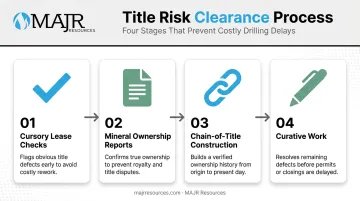
- Cursory lease checks to confirm land is available and free of immediate obstructions
- Mineral ownership reports identifying who actually holds the rights, down to trusts and probate estates
- Chain-of-title construction tracing ownership through decades of deeds, wills, and court records
- Curative workto draft correction deeds, obtain ratifications, and resolve heirship gaps before an attorney issues a final title opinion
Catching these problems early prevents production delays and legal disputes, and it protects capital that's already been committed. It also strengthens investor and lender confidence, since rigorous ownership verification lowers a project's risk profile.
KPIs impacted: time-to-first-production, number of title disputes, downtime hours, capital at risk.
This advantage carries the most weight on multi-regional acquisitions, complex pooled units, or properties with a long, fragmented ownership history.
Access to Specialized Expertise and Scalable Support
Land, title, and regulatory work demands niche expertise(GIS technology, legal compliance, multi-state filing requirements) that's expensive to build and maintain in-house, especially for smaller operators.
Outsourcing partners flex capacity up during active leasing or acquisition phases and down during quieter stretches, without carrying the fixed cost of full-time staff. That converts a fixed administrative cost into a variable one tied to actual activity, which improves capital efficiency.
What this looks like in practice:
- Local landmen staffed by region, since title and regulatory environments differ sharply between, say, North Dakota and East Texas
- GIS-based spatial analysis layered on top of historical title research to confirm boundaries and ownership
- Legal compliance review running in parallel, not as an afterthought
MAJR Resources, for example, has extended its research and negotiation capabilities beyond the Permian Basin into North Dakota, Oklahoma, New Mexico, Arizona, Mississippi, Louisiana, Pennsylvania, Tennessee, and Ohio. Coverage also extends to the Texas Panhandle, North Texas, South Texas, and East Texas. Each of those regions carries its own regulatory quirks, and local familiarity matters more than most operators expect.
KPIs impacted: cost per acre acquired, administrative overhead ratio, scalability of due diligence capacity.
The payoff is greatest during rapid growth phases, multi-state expansion, or when entering a new basin without existing local relationships.
What Happens When Oil and Gas Outsourcing Is Missing or Ignored
Keeping land and title work entirely in-house, without the resources to support it properly, tends to produce a predictable set of problems:
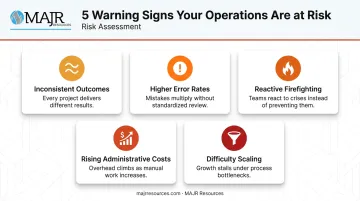
- Inconsistent lease and title outcomes as overstretched staff try to cover too much ground
- Higher error rates in ownership verification, leading to payment disputes or suspense issues
- Reactive firefighting when title defects surface late, sometimes days before a scheduled spud
- Rising administrative costs from scrambling to hire and train specialized staff on short notice
- Difficulty scaling land work during acquisition or expansion phases
Texas rules add real teeth to these consequences. Royalty payments generally must go out within specific windows: often 120 days after first sale, then 60 days for oil and 90 days for gas thereafter. A title dispute or ownership question can justify suspending payment, but miss those windows without a valid reason, and interest starts accruing.
None of this is theoretical. It's the direct result of treating land administration as a side task rather than a discipline that requires dedicated attention.
How to Get the Most Value from Oil and Gas Outsourcing
Outsourcing works best as an ongoing partnership, not a one-off transaction. That means regular communication, clearly defined deliverables, and outcomes measured against real metrics, such as title clearance time, lease turnaround, and cost per acquisition, rather than assumptions.
A few things separate a strong partnership from a weak one:
- Proven multi-state experience: a partner who understands regional regulatory differences, not just one basin
- Integrated capabilities: historical research, GIS analysis, and legal compliance working together rather than as siloed reports
- A dedicated point of coordination: someone managing the full picture so insights from due diligence get acted on quickly
MAJR Resources has refined exactly this kind of full-service approach since 2005. Chain-of-title research feeds directly into GIS-based spatial analysis, which is then evaluated against current legal and regulatory requirements. A single project management structure coordinates all three pieces, instead of leaving them as separate, disconnected deliverables. This coordinated approach solves problems as they surface, rather than simply cataloging them for someone else to fix.
Conclusion
The real value of oil and gas outsourcing extends well beyond line-item savings. It comes from operational control, clarity, and consistency across every phase of a project.
Freed-up internal focus and minimized downtime compound with scalable expertise as leasing and acquisition activity grows. The busier things get, the more that compounding matters.
Treat outsourcing land and title work as an ongoing operational strategy, not a one-time fix, and choose a partner like MAJR Resources with a track record that backs it up.
Frequently Asked Questions
What functions are typically outsourced in oil and gas operations?
Land and title research, lease negotiation, division order processing, revenue accounting, and regulatory reporting are the most commonly outsourced functions. These are specialized, time-intensive tasks that sit outside most operators' core drilling and production focus.
Is outsourcing land and title services cost-effective for small operators?
Yes. Outsourcing converts fixed administrative costs into variable ones, giving smaller operators access to specialized expertise without carrying the overhead of a full in-house department.
How does outsourcing reduce operational downtime?
Proactive title and ownership verification catches problems like defective deeds, heirship gaps, or unclear mineral rights before drilling begins, rather than after capital has already been committed.
Can outsourced land services scale as drilling activity increases?
Reputable partners flex capacity up or down based on leasing volume. That avoids the delays of hiring and training in-house staff during a busy acquisition phase.
What should I look for in an oil and gas outsourcing partner?
Look for industry experience, geographic capabilities across multiple states, integrated technology like GIS, and a demonstrated track record of resolving title issues before they become drilling-day problems.
Does land and title outsourcing apply to renewable energy projects too?
Yes. Many landman and mineral rights partners, including MAJR Resources, apply the same due diligence and negotiation expertise to renewable energy and infrastructure development projects.