
For executives, investors, and mineral rights holders, keeping track of which deals matter, and why, is a real challenge. Deal structures vary, regulatory reviews drag on for months, and the strategic logic isn't always obvious from headlines alone.
This article breaks down the biggest recent oil and gas deals, the trends fueling this wave of consolidation, and the due diligence work that determines whether an acquisition actually pays off.
Key Takeaways
- "Serial acquirers" deliver outsized shareholder returns versus companies sitting on the sidelines
- Exxon-Pioneer, Chevron-Hess, and Diamondback-Endeavor anchored recent Permian Basin consolidation
- Deal volume tracks oil price "trigger zones," slowing sharply below $65 crude
- Title and mineral rights due diligence is the most overlooked factor in deal success
Oil and Gas M&A at a Glance
U.S. upstream M&A hit a record $192 billion in 2023, according to a record-setting Q4 report from Enverus, driven largely by a blockbuster fourth quarter worth $144 billion on its own. That momentum didn't hold.
Deal value dropped to $105 billion in 2024, a 45% decline from the prior year. The slowdown followed a clear pattern:
- 1Q24: $51 billion
- 3Q24: $12.4 billion
- 4Q24: $9.6 billion, the fourth straight quarterly decline
One segment bucked the trend. Gas-focused upstream M&A topped $20 billion in 2024, roughly four times what it was the year before.
What's Driving the Deals
Despite the cooldown, the strategic logic behind these transactions hasn't changed:
- Scale in core basins reduces per-barrel operating costs
- Market share consolidation strengthens pricing power and negotiating leverage
- Cost synergies from combined operations, drilling programs, and infrastructure
- Access to premier acreage, especially in the Permian Basin, where remaining high-quality inventory keeps shrinking
Notable Oil and Gas Mergers and Acquisitions
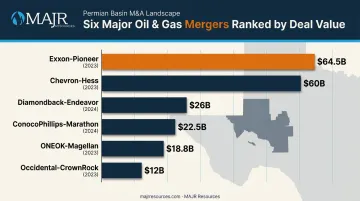
The past two years produced the largest run of oil and gas consolidation in a generation. Here's a rundown of the six deals that mattered most, ranked roughly by size.
ExxonMobil and Pioneer Natural Resources
Announced in October 2023 and closed in May 2024, this all-stock deal valued Pioneer at $59.5 billion in equity, or roughly $64.5 billion including debt. Exxon paid 2.3234 shares of its own stock for every Pioneer share.
The deal doubled Exxon's Permian footprint, combining Pioneer's approximately 850,000 Midland Basin acres with Exxon's existing 570,000.
The deal also drew sharp regulatory attention. The FTC's final order barred former Pioneer CEO Scott Sheffield from joining Exxon's board over antitrust concerns tied to alleged price signaling with OPEC, though the FTC later set that order aside in July 2025.
Chevron and Hess
Chevron announced its $53 billion equity acquisition of Hess in October 2023, though the deal didn't close until July 2025 after prolonged arbitration with ExxonMobil over Guyana asset rights. The all-stock structure paid 1.025 Chevron shares per Hess share, valuing the deal near $60 billion on an enterprise basis.
The prize wasn't Permian acreage this time. Chevron gained Hess's 30% stake in the Stabroek Block offshore Guyana, one of the most significant oil discoveries in decades, plus 465,000 net Bakken acres.
As with Exxon-Pioneer, the FTC barred Hess CEO John Hess from Chevron's board before eventually setting that condition aside.
Diamondback Energy and Endeavor Energy
Diamondback's February 2024 acquisition of privately held Endeavor Energy carried an approximate $26 billion value, including Endeavor's net debt. The structure combined 117.3 million Diamondback shares with $8 billion in cash.
The combination added roughly 838,000 net Permian acres, merging two operators known for tight-margin efficiency. CEO Travis Stice pointed to the company's "industry-leading depth" and "lowest cost structure" as the rationale. Management projected about 10% free-cash-flow-per-share accretion in 2025 and $550 million in annual synergies.
ConocoPhillips and Marathon Oil
This all-stock deal, announced in May 2024 and closed that November, valued Marathon at $22.5 billion on an enterprise basis, including $5.4 billion in net debt. ConocoPhillips exchanged 0.255 shares for every Marathon share.
Unlike the Permian-centric deals above, this one broadened ConocoPhillips's footprint into the Eagle Ford, Bakken, and Delaware Basin. The company expected the deal to be immediately accretive to earnings and cash flow, targeting $500 million in run-rate cost savings within the first year.
ONEOK and Magellan Midstream Partners
ONEOK's May 2023 acquisition of Magellan Midstream came to roughly $18.8 billion, including assumed debt, paid through $25 in cash plus 0.667 ONEOK shares per Magellan unit.
The combination merged ONEOK's natural gas and NGL infrastructure with Magellan's refined-products and crude pipeline network, creating a system spanning more than 25,000 pipeline miles. ONEOK projected 3% to 7% EPS accretion between 2025 and 2027, with at least $200 million in annual synergies.
Occidental Petroleum and CrownRock
Occidental's December 2023 acquisition of privately held CrownRock closed at roughly $12 billion, including $1.2 billion of assumed debt. The deal was funded with $9.1 billion in new debt and about $1.7 billion in common equity.
CrownRock brought approximately 170,000 barrels of oil equivalent per day and 1,700 undeveloped Midland Basin drilling locations into Occidental's Permian portfolio. Occidental forecast about $1 billion in incremental first-year free cash flow at $70 per barrel WTI. Given the Permian focus, this deal carries particular weight for Texas-based operators and mineral owners tracking ownership shifts in the region.
Key Trends Shaping Oil and Gas M&A Today
The Serial Acquirer Advantage
Companies that complete at least one acquisition per year generated 130% higher total shareholder returns than non-acquirers between 2012 and 2022, according to Bain & Company's research. That premium was 57% between 2000 and 2010, meaning the gap between active and passive companies has widened considerably.
This isn't proof that dealmaking alone drives returns. But it does explain why companies like Diamondback and Occidental keep showing up on acquisition lists year after year.
A Lower Trigger Zone for Deals
That premium doesn't appear out of nowhere; timing matters too. Crude prices sitting in the mid-$60s per barrel or lower have suppressed seller activity through 2025, per Enverus data. Only about 1,800 private-equity-held shale locations generate a modeled 10% return at $50 WTI, while another 6,700 need higher prices to pencil out.
That's a meaningfully lower bar than prior cycles, where deal activity typically required $70-plus crude to get moving.
Natural Gas Takes Center Stage
Gas-focused M&A isn't just a footnote anymore. U.S. LNG exports averaged 11.9 Bcf/d in 2024, roughly flat with 2023, but capacity is where the real story sits. The EIA projects the U.S. will add 13.9 Bcf/d of liquefaction capacity between 2025 and 2029.
Layer in data center demand, and the picture sharpens further. S&P Global Ratings estimates AI and data center growth could add 3 to 6 Bcf/d of new U.S. gas demand by 2030.
Yield Versus Growth
That demand growth raises a bigger question: where should capital go first? Buyers today are balancing two competing priorities:
- Shareholder payouts through dividends and buybacks
- M&A spending on acreage and infrastructure
Investors have grown less patient with growth-at-all-costs strategies. Equity-based deals, like Exxon-Pioneer and Chevron-Hess, have become more common precisely because they let acquirers preserve cash for shareholder returns while still growing reserves.
Private Equity Rotates Toward Infrastructure
That same capital question is playing out differently in private equity. Private equity capital is shifting away from upstream divestitures and toward export-oriented midstream assets. PE investment in oil and gas transportation reached $4.0 billion across 13 deals through early August 2025, up from $3.36 billion across 12 deals in the same period a year earlier. Recent examples include a $175 million Rio Grande LNG facility stake and Apollo's $1 billion investment for 25% of BP Pipelines.
The Oil and Gas M&A Process: How Deals Come Together
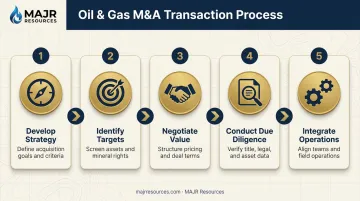
Every major deal follows a similar arc, even when the assets and dollar figures differ wildly.
- Develop strategy: Assess the portfolio, define an acquisition thesis, and set capital and risk parameters
- Identify targets: Screen potential targets against strategic fit, geography, and asset quality
- Negotiate value: Model financials, structure tax terms, and finalize letters of intent and purchase agreements
- Conduct due diligence: Review commercial, financial, operational, legal, title, environmental, and regulatory factors
- Integrate operations: Combine operating models, finance systems, and workforce structures post-close
Due diligence is consistently where deals stall or lose negotiated value if rushed. Title defects carry real financial consequences:
- Waives a valid claim when a contractual notice deadline lapses
- Reduces the purchase price when defects remain uncured before closing
- Triggers walk-away rights when defects exceed the agreed threshold
MAJR Resources handles this curative work daily for Permian Basin clients, tracking notice deadlines and coordinating title fixes before they jeopardize a deal.
Practitioners often describe a 30- to 45-day title diligence window as standard, though this varies by deal complexity. Integration work, particularly reconciling land and title records across combined portfolios, frequently takes months longer than either party initially expects.
Why Land and Mineral Title Due Diligence Determines M&A Success
In nearly every upstream and midstream deal, confirming who actually owns the mineral rights and leases in question is what separates a clean acquisition from an expensive mistake. A deal's headline value means little if the underlying title turns out to be clouded.
Where Deals Go Sideways
Title problems tend to fall into recurring patterns:
- Gaps in the chain of title from unrecorded deeds or clerical errors
- Undisclosed heirs surfacing when an estate never completes probate
- Severed mineral and surface estates with incomplete records of how the split occurred
- Conflicting conveyances, where a seller conveys the same interest to more than one buyer
- Unpaid taxes, liens, or overriding royalty interests that reduce the net value of what's being acquired
Any one of these can delay a closing or force a renegotiated price.
The Consolidation Complexity Problem
As mega-deals concentrate more Permian acreage into fewer hands, the mineral histories behind that acreage get more tangled, not less. A single tract might carry ownership fragments traced back through multiple generations, several severance events, and dozens of individual heirs. Verifying all of it before closing takes specialized, methodical work.
MAJR Resources, based in Monahans, Texas, handles exactly this kind of research across the Permian Basin. Its landmen conduct full-title research spanning:
- Chain of title analysis back to the original government grant or patent
- Lease review for validity, royalty terms, and regulatory compliance
- Environmental and regulatory risk assessment
- GIS-based mapping to confirm legal boundaries match physical property lines
- Mineral interest valuation to support fair negotiation
When defects surface, MAJR provides curative services, drafting the documents needed to clear title before a deal closes rather than after. This same rigor applies whether the transaction involves traditional oil and gas leases or the renewable energy and infrastructure land acquisitions now common across Texas.

Frequently Asked Questions
What are the 4 types of acquisitions?
The four main types are horizontal (combining direct competitors, like Exxon-Pioneer), vertical (linking a supplier and purchaser, such as an E&P acquiring gathering infrastructure), conglomerate (combining unrelated businesses), and market extension (entering a new geographic basin).
What are acquisition costs in oil and gas?
Costs include the purchase price plus due diligence expenses, legal and title verification work, regulatory filing fees, and post-close integration costs. Advisory, legal, and accounting fees are typically expensed separately rather than folded into the deal consideration.
What is the largest oil and gas merger in recent history?
ExxonMobil's acquisition of Pioneer Natural Resources, valued at roughly $64.5 billion including debt, stands as the largest recent U.S. transaction. The all-stock deal doubled Exxon's Permian Basin acreage position.
Why are oil and gas companies merging so frequently right now?
Companies are consolidating for scale, cost synergies, and stronger positioning ahead of natural gas demand growth tied to LNG exports and AI data centers. Serial acquirers have also outperformed passive companies on shareholder returns, reinforcing the pattern.
How do oil and gas mergers affect mineral rights owners?
Ownership transfers require updated lease and title verification, which can affect royalty payment timing and contract terms. Landman service providers like MAJR Resources handle this chain-of-title work, helping mineral owners confirm their lease status and payee information whenever an operator changes hands.
What is the difference between upstream, midstream, and downstream M&A?
Upstream deals involve exploration and production assets, midstream covers pipelines, gathering, and storage infrastructure, and downstream involves refining and distribution to end users. Each segment carries distinct due diligence priorities and regulatory considerations.