Introduction
Solar developers are knocking on more rural doors than ever. NREL projects utility-scale solar could require between 3.49 million and 10.32 million new acres by 2035, depending on how fast the country builds out capacity. That demand is landing on farms, ranches, and vacant tracts from Texas to Pennsylvania.
If you've fielded a call from a landman lately, the numbers probably didn't add up. One neighbor mentions $500 per acre, while another says $1,500 — and neither is wrong. Solar lease rates vary enormously by location, land size, grid access, and negotiated terms. There's no single "market rate."
This guide breaks down typical rate ranges, the factors that move pricing up or down, how payments actually get structured, and how to negotiate a lease that protects your land and income for decades.
Key Takeaways
- Lease offers typically range from $1,000 to $1,500+ per acre annually, varying by location and scale
- Grid proximity, land size, topography, and zoning drive most pricing differences
- Expect base rent, 1-2.5% annual escalators, and sometimes upfront option payments
- A high headline rate means little without solid decommissioning terms and guarantees
- Independent title and land review before signing prevents costly, decades-long mistakes
How Much Do Solar Farms Pay to Lease Land? (Pricing Overview)
Solar lease rates aren't set by any national schedule. They shift with regional demand, land quality, and how badly a developer needs your specific parcel for interconnection.
Landowners commonly misjudge lease value in a few predictable ways:
- Assuming the advertised rate covers the whole parcel, not just the fenced array footprint
- Ignoring escalator clauses and comparing only the year-one payment
- Signing without a minimum acreage guarantee, leaving compensation exposed if the developer builds on less land than originally proposed
Real offer data helps correct these assumptions. What current data shows: Purdue University's January 2025 Ag Economy Barometer found that 40% of landowners who had discussed solar leasing reported offers of at least $1,250 per acre annually, and 26% reported offers of $1,500 or more. Six months earlier, 55% of respondents with recent lease conversations reported offers above $1,000 per acre.
These figures describe offers, not signed contracts, and no verified national source breaks them out by project size. Treat them as a benchmark, not a guarantee.
The ranges typically cover base rent for acreage actually used inside the fenced array. They usually exclude separate payment for access roads, cable runs, and other restricted-use easement acreage outside that fence line.
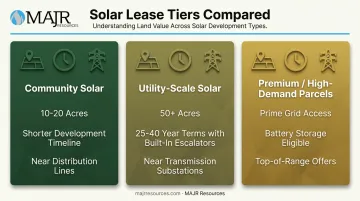
Community Solar Leases (Roughly 10-20 Acres)
Smaller community solar projects typically pay per-acre annual rent with shorter development timelines. These work best on smaller parcels near existing distribution lines, where interconnection costs stay manageable.
Utility-Scale Solar Leases (50+ Acres)
Utility-scale projects bring higher aggregate payouts across 25-40 year terms, usually with built-in escalator clauses. They suit large, flat parcels near transmission substations where construction runs efficiently.
Premium / High-Demand Parcels
Parcels with prime grid access, or land eligible for co-located battery storage, tend to land at the top of the offer range. Landowners in these strong-interconnection markets hold the most bargaining power.
Key Factors That Affect Solar Farm Lease Rates
Every per-acre offer reflects a mix of technical, environmental, and market considerations. Here's what actually moves the number.
Proximity to Utility Infrastructure
Distance to substations and transmission lines directly affects interconnection cost. Developers favor parcels near high-voltage lines because shorter connections mean lower construction costs, savings that often show up as a higher offer for you. A parcel within a mile of an existing substation can save a developer hundreds of thousands of dollars in line construction, and that savings frequently gets reflected in the lease offer itself.
Land Size, Topography & Soil Quality
Flat, unobstructed, well-draining land increases desirability. Developers weigh:
- Slope, drainage, and shading
- Existing pipelines, rock, or root density
- Overall parcel size and access
Larger, contiguous tracts requiring minimal grading reduce construction costs, which can translate into a stronger offer. A flat 200-acre parcel, for instance, typically commands a better per-acre rate than a fragmented 50-acre site that needs extensive earthwork.
Environmental & Zoning Constraints
Wetlands, protected habitats, and local zoning ordinances can shrink usable acreage well below what's on your deed. A 100-acre parcel with 20 acres of wetlands and required setbacks might only support 60 buildable acres. Rent typically applies to what's built, not gross acreage.
Market Demand for Renewable Energy
State renewable portfolio standards create real procurement pressure. Michigan's Public Act 235, for example, requires covered utilities to reach 50% renewable energy from 2030-2034 and 60% from 2035 onward. States with aggressive targets and constrained grid capacity tend to see more competitive offers among developers.
Contract Length & Negotiated Terms
According to Penn State Extension's landowner guide, annual escalators commonly run 1% to 2.5%, compounding over a 25-year base term plus possible 5- and 10-year extensions. A lower starting rate with a strong escalator can outearn a higher flat rate within a decade.
Solar Lease Payment Structure: What Landowners Actually Get Paid
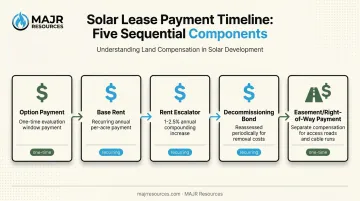
The advertised per-acre number is one piece of a larger puzzle. A full lease typically includes several distinct payment components, each with its own timing:
| Payment Component | Timing | What It Covers |
|---|---|---|
| Option payment | One-time or periodic | Paid during the 2-5 year evaluation period before the full lease is finalized |
| Base rent | Recurring, annual | Per-acre payment calculated only on acreage the array actually uses |
| Rent escalator | Recurring | Built-in annual increase, commonly 1-2.5%, compounding over the term |
| Decommissioning bond | Reassessed periodically | Financial guarantee that funds exist to remove equipment and restore land |
| Easement/right-of-way payment | One-time or recurring | Separate compensation for access roads and cable runs outside the fenced array |
Option payments deserve attention because they're often modest by design. Developers keep this figure low since they haven't committed to building yet. Sample clauses reviewed by the National Agricultural Law Center show initial option payments as low as $2,500 plus quarterly installments. That figure should climb substantially once construction begins.
Beyond option payments, easement compensation is the detail most landowners miss entirely. Access roads and cable runs often sit outside the fenced array but still restrict how you use that land. If your contract folds this into base rent without a separate line item, you're likely leaving money on the table and losing clarity on how much acreage is genuinely restricted.
Confirm these details before signing:
- Does the option payment convert automatically once the lease is exercised?
- How does the escalator compound—annually or only at renewal?
- Are easement and right-of-way payments itemized separately from base rent?
Low-Paying vs High-Paying Solar Leases — What's the Difference
Two neighboring parcels of similar size can land very different offers, and the gap usually comes down to location, contract terms, and legal protections.
| Factor | Lower-Paying Lease | Higher-Paying Lease |
|---|---|---|
| Location & grid access | Farther from substations; interconnection cost passed to you | Prime proximity to transmission infrastructure |
| Contract terms & escalators | Flat rate, no escalator, unclear acreage guarantees | Built-in annual escalators plus minimum-acreage payments |
| Decommissioning & legal protections | Vague restoration language, no reassessed bond | Clear removal terms backed by a periodically updated bond |
Before signing, check these three items:
- Confirm distance to the nearest substation
- Verify annual escalator and acreage guarantees
- Review the decommissioning bond's reassessment schedule
The difference between these two outcomes can run into hundreds of thousands of dollars over a 25-year term. Rate alone tells you almost nothing until you've read the entire contract.
How to Negotiate a Fair Solar Lease Rate (and Avoid Costly Mistakes)
The highest initial offer isn't automatically the best deal. Without proper review, an impressive per-acre number can hide problems that cost far more over 25 to 40 years.
Get an Independent Land and Title Review First
Before signing any option or lease, have an experienced landman review your property. Firms like MAJR Resources have handled land and title work in Texas energy markets since 2005.
A thorough review typically includes:
- Title examinations tracing ownership through deeds and historical records
- Checks for liens or encumbrances against the property
- Flags for severed mineral rights or active oil and gas leases that could conflict with a solar project
These conflicts matter for renewable deals just as much as traditional ones. A carryover lease obligation or fragmented mineral ownership can derail a solar agreement months after signing.
Negotiate a Minimum Acreage or Payment Guarantee
Don't let compensation shrink if the developer ultimately builds on less land than proposed. A minimum acreage guarantee locks in payment based on the acreage originally discussed.
Insist on Decommissioning Language and a Reassessed Bond
Vague restoration promises aren't enough. Push for:
- Clear removal timelines and restoration standards in the lease itself
- A decommissioning bond or other funded financial security
- Periodic reassessment of that bond, so it reflects real removal costs rather than a stale year-one estimate
Common Mistakes to Avoid
- Focusing only on the headline per-acre number instead of total lifetime value
- Skipping legal or title review to speed up signing
- Overlooking compensation for restricted-use easement acreage
- Underestimating that this is a multi-decade commitment, often outlasting your own ownership of the property
Frequently Asked Questions
What's the minimum acreage for a solar farm?
Most utility-scale developers look for at least 10 to 30 usable, flat acres, though requirements shift based on project type and available interconnection capacity.
How many solar farms are in PA?
Pennsylvania had 46 operating solar facilities totaling 562 MW as of late 2024, with 9 more under construction and 20 in planning. The state's Alternative Energy Portfolio Standard requires 18% alternative energy generation overall.
How much can I expect to be paid per acre for a solar lease?
National surveys show a large share of recent offers landing between $1,000 and $1,500+ per acre annually, though your location, land quality, and grid access can push that number significantly in either direction.
How long do solar land leases typically last?
Standard terms run 25 years, often with 5- and 10-year extension options that can stretch the total commitment to 40 years.
Can I still farm or graze my land under a solar lease?
Yes, if the lease specifically allows it. Sheep grazing for vegetation control and pollinator habitat arrangements are increasingly common, but they need to be written into the agreement.
Should I hire a land professional or attorney before signing a solar lease?
Given the decades-long commitment and significant lifetime value of these contracts, an independent title and land review before signing is worth the cost. Firms specializing in mineral rights and land due diligence, such as MAJR Resources, can verify ownership and catch costly problems before they surface.