That uncertainty is common, and it's expensive. Easements sound like routine paperwork, but they can permanently restrict how you use your land, shrink its resale value, and lock you into compensation that doesn't reflect your actual losses. Once recorded, most of these agreements never expire.
This guide breaks down what a transmission line easement actually is, how wide the corridor can get, the specific ways it can hurt you financially and legally, and what to do before you sign anything.
Key Takeaways
- Transmission easements grant permanent utility land use while you retain legal title
- Widths typically run 75 to 200+ feet, with 500kV lines needing the widest corridors
- Unnegotiated easements can lower property value, block development, or cut your payout
- You hold the most leverage during routing and negotiation, before eminent domain applies
- Vegetation and access rights often extend beyond the mapped easement boundary
What Is a Transmission Line Easement?
An easement is a legal right to use someone else's land for a specific purpose, without owning it. You keep the deed. The utility gets a defined right to do something on a strip of your property.
A transmission line easement grants a utility the right to build, operate, and maintain high-voltage lines across a specific corridor. According to the Wisconsin Public Service Commission, the recorded grant is the legal contract that should spell out both the line's voltage and the right-of-way width.
Here's the part most landowners underestimate: these easements are usually permanent and transfer automatically with the sale of the property. Dominion Energy states that most of its transmission easements are perpetual. Utilities like TVA and Evergy have corridors that have operated for decades. Evergy notes a De Soto-area line dating to the 1970s that's now being upgraded, still running under its original grant.
Transmission Lines vs. Distribution Lines
Not all power lines carry the same weight, literally or legally.
- Transmission lines move bulk, high-voltage power (commonly 115kV to 765kV) from generation plants to substations
- Distribution lines carry lower voltage from substations directly to homes and businesses
Because transmission lines feed entire regions rather than individual neighborhoods, disputes or outages on them ripple across a much larger footprint. That's part of why utilities push hard for broad, durable easement rights. This split matters practically: an easement's authorized voltage class is usually stated directly in the grant, so check that document to confirm which category applies to your property.
How Transmission Line Easements Are Created
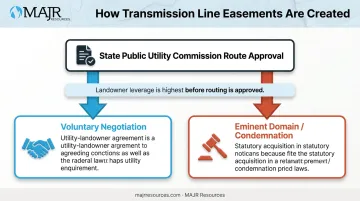
Easements come about two ways:
- Voluntary negotiation: the utility approaches you directly with an offer
- Eminent domain (condemnation): the utility uses statutory authority to acquire the easement even without your agreement
Most transmission utilities hold eminent domain authority for these projects. Before any easement acquisition begins, a state Public Utility Commission typically approves the line's general route, often through a certification process that includes an environmental report and a public hearing. This routing stage is where landowner input carries the most weight. Once a corridor is approved, your negotiating position narrows considerably.
How Wide Is a Transmission Line Easement?
Width depends almost entirely on voltage and the number of circuits on the structure. Published utility benchmarks give a rough sense of what to expect:
| Voltage Class | Typical Width | Source |
|---|---|---|
| 46/69kV | 75–100 ft | TVA |
| 115kV | 100 ft | Georgia Transmission |
| 161kV | 100–150 ft | TVA |
| 230kV | 150 ft | TVA |
| 500kV | 175–200+ ft | TVA / NRC |
These figures are common industry benchmarks, not guarantees. The only document that legally controls width and location on your specific parcel is the recorded easement grant, not a project map, a utility brochure, or even a plat.
Why width matters in practice: a wider corridor restricts your usable acreage in several ways:
- Reduces land available for structures or planting
- Requires more vegetation clearing within the corridor
- Increases construction and maintenance access across your property On a smaller parcel, a 200-foot corridor for a 500kV line can consume a meaningful share of usable acreage, affecting everything from where you can build a barn to how you plan crop rotations.
Because published widths are only estimates, matching the recorded grant to an accurate survey is the only way to confirm your actual exposure. MAJR Resources uses GIS-based overlay to translate the legal description from a recorded easement document into a precise map of your parcel. This shows exactly where the corridor falls, rather than relying on a general project drawing.
How a Transmission Line Easement Can Hurt You
The letter you received probably framed the easement as a simple land-use agreement. It's rarely that simple.
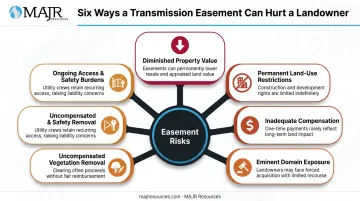
Diminished property value and marketability. A 2010 peer-reviewed literature review found that when transmission lines negatively affected property value, the impact was usually under 10%, often landing in the 3%-6% range, though several studies found no measurable effect at all (Jackson and Pitts literature review).
The effect isn't universal, but buyers who are wary of visible towers can still slow a sale or push down offers.
Permanent restrictions on land use. Easement agreements commonly block:
- Construction of buildings or permanent structures
- Septic tanks and drain fields
- Solar panel installation within the "wire zone"
- Tall trees or certain fencing types near the corridor
These restrictions often extend beyond the easement's mapped boundary, not just within it.
Inadequate compensation. A lump-sum offer for the easement strip alone can miss the bigger picture. If the project reduces the value of the remaining, unaffected portion of your land — known as severance or residue damage — you may be owed additional compensation. Proving it typically requires maps, soil or crop data, and a dedicated appraisal.
Eminent domain exposure. If you decline a negotiated offer, many utilities can still acquire the easement through condemnation. North Carolina, for example, grants qualifying private corporations eminent domain authority for electric power lines under statute, along with a 30-day notice requirement before survey and appraisal work begins (NC General Statutes Chapter 40A).
Once condemnation starts, you generally lose control over final terms.
Uncompensated vegetation removal. Utilities retain rights to remove "danger trees" that threaten the line, even outside the easement boundary, typically without payment:
- Duke Energy clears vegetation posing a threat to line integrity, often at no cost to the landowner
- Dominion Energy follows comparable danger-tree removal practices
- TVA has stated it generally has no obligation to pay for trees removed from the right-of-way
Ongoing access and safety burdens. Recurring rights of entry for inspection and maintenance affect your privacy. Clearance requirements can also limit the height of equipment, sheds, or structures you can safely operate near the line.
What You Can and Cannot Do on Easement Land
Despite these restrictions, an easement doesn't turn your land into someone else's property. Most agreements still allow:
- Pasture and grazing
- Crops and gardens
- Lawns and open space
- Driveways or parking areas (with prior utility approval)
Common restrictions typically prohibit:
- Permanent structures and buildings
- Septic systems or drain fields
- Certain fence types that block access
- Burning debris near the corridor
- Solar panels within the wire zone
One point often overlooked: you're still on the hook for property taxes, fence and gate upkeep, and local zoning compliance on the easement portion of your land. That responsibility remains even though your use of it is limited. The utility gains rights; it doesn't inherit your obligations.
How to Protect Yourself Before and After Signing an Easement Agreement
The negotiation stage is where you have the most control. Here's how to use it.
Run a historical title search. Some easements date back decades, and TVA notes that tracing old grants may require records reaching 100 years. MAJR Resources' title research spans surface rights to leasehold interests, uncovering recorded easements and rights-of-way beyond mineral ownership, so you know exactly what's on file before you negotiate.
Get an independent appraisal. Don't accept the utility's first number. A proper valuation accounts for both the easement strip and any severance damage to the rest of your property.
Negotiate terms beyond dollars. Specific language on access routes, advance notice requirements, restoration obligations after construction, and reserved rights for farming or fencing can matter more over 30 years than the initial payment.
Consult an attorney before signing — particularly if the utility has signaled it may pursue condemnation if terms aren't reached.
Research your state's specific rules. Compensation standards, routing procedures, and eminent domain statutes vary widely by state. Check your state's Public Utility Commission process before responding to any offer.
GIS mapping can also help here. Overlaying a recorded easement's legal description onto your actual parcel boundaries shows exactly how many feet of your land are affected, which is far more useful than eyeballing a project brochure.
Frequently Asked Questions
What is a transmission line easement?
It's a legal right granted to a utility to build, operate, and maintain high-voltage power lines across your property. You keep title to the land, but your use of the easement strip is permanently restricted.
How wide is a 500kV transmission line easement?
Published examples show 175 to 200+ feet as typical for 500kV lines. The exact width for your property depends entirely on the recorded easement document, not general benchmarks.
What are the easement laws in Texas?
Texas statutes, including provisions in the Texas Property Code and Texas Utilities Code, govern eminent domain authority, survey notice requirements, and compensation for partial takings. Consult the Texas Statutes or a local real estate attorney for specifics on your situation.
Can I sell land that has a transmission line easement on it?
Yes. The easement stays attached to the property and transfers to the new owner, so it must be disclosed. It can still affect buyer interest and final sale price.
Do transmission line easements ever expire or get removed?
Most are permanent unless the original agreement specifies a term, or the utility formally decommissions the line and records a release. Don't assume decommissioning alone clears the title.
How much compensation should I expect for a transmission line easement?
Compensation varies based on land value, easement width, and severance damage to the remaining property. Get an independent appraisal rather than relying solely on the utility's initial offer.