Introduction
Owning mineral rights puts you at a crossroads most people never expect to face. Lease them. Sell them. Or buy more.
Each path carries different financial outcomes, different legal risks, and different long-term consequences. Many owners don't fully understand the value of what they hold — or even the difference between mineral rights and royalty rights.
That confusion has cost families real money in undervalued deals and missed negotiations.
This guide breaks down how leasing, selling, and buying actually work. You'll learn how to weigh the trade-offs, spot the red flags in ownership history, and understand why professional verification, often handled by experienced land services teams like MAJR Resources, should happen before you sign anything.
Key Takeaways
- Leasing preserves ownership and generates royalty income
- Selling delivers a lump sum but forfeits all future upside
- Buying mineral rights can pay off, but only with rigorous title and production verification first
- Mixing up mineral rights and royalty rights is one of the costliest mistakes owners make
- Professional title research reduces legal risk and protects value no matter which path you choose
What Are Mineral Rights?
Mineral rights are the legal right to explore, extract, and profit from subsurface resources like oil, gas, and coal. This is a separate legal interest from surface rights, which cover the use of the land itself: farming it, building on it, or living on it.
In many parts of the U.S., these two estates were split decades ago through a deed severance. Once severed, mineral ownership can pass down through generations, get divided among heirs, or change hands entirely, all while the surface stays with a completely different owner.
Mineral Rights vs. Royalty Rights vs. Surface Rights
This is where owners get tripped up. The terms sound interchangeable, but legally, they're not:
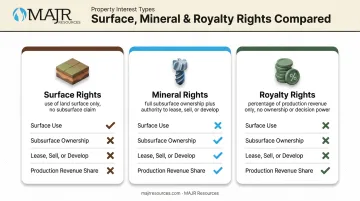
- Surface rights cover use of the land's surface only, with no claim to what's underground
- Mineral rights include full ownership of subsurface resources, plus the authority to lease, sell, or develop them
- Royalty rights only entitle the holder to a percentage of production revenue — with zero ownership or decision-making power
Someone holding only royalty rights can't negotiate a lease, block drilling, or sell development rights. They just collect a check if production happens. Confusing the two categories during a sale or lease negotiation is a fast way to accept far less than your interest is worth.
Why Ownership Verification Comes First
Before leasing, selling, or buying anything, you need to know exactly what you own. Deeds should state whether subsurface rights were severed at some point — but that language isn't always clear, and it isn't always recorded properly.
County Recorder of Deeds offices hold this history, but many severances from the late 1800s and early 1900s used vague terminology that courts still argue over today.
Consider Butler v. Charles Powers Estate, decided by the Pennsylvania Supreme Court in 2013. An 1881 deed reserved "one-half the minerals and Petroleum Oils" for a previous owner's heirs.
More than a century later, once Marcellus Shale drilling made the property valuable, the surface owners and the reservation holder's heirs ended up in court fighting over whether "minerals" legally included natural gas. The Pennsylvania Supreme Court ultimately ruled that it didn't, reversing a lower court decision and reinstating judgment for the surface owners.
That's not an isolated case. It's a reminder that unclear or unrecorded reservations can surface decades later and change who actually owns what.
Leasing Your Mineral Rights
Leasing means granting a company (the lessee) temporary rights to explore and produce minerals on your property. You, the lessor, keep ownership the entire time.
How Mineral Leasing Works
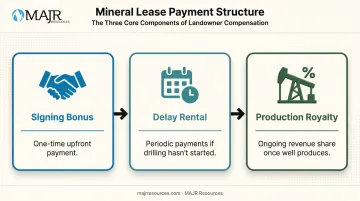
A typical lease has three payment components:
- Signing bonus: an upfront, one-time payment for granting the lease
- Delay rental: periodic payments if drilling hasn't started yet within the lease term
- Production royalty: your ongoing share of revenue once the well produces
Royalty percentages are negotiable, but many states set a floor. Texas doesn't impose a statutory minimum on private leases broadly, though it applies to certain state and public lands under the Natural Resources Code. Pennsylvania takes a stricter approach: its Oil and Gas Lease Act requires a minimum one-eighth (12.5%) royalty on any oil or gas removed, or the lease is invalid.
Beyond royalty rates, the lease term determines how long that commitment lasts. Leases run for a primary term, often three to five years. If a well is drilled and starts producing before that term expires, the lease can be held by production (HBP), meaning it continues indefinitely as long as production continues.
If no well is drilled before the term expires, the lease simply terminates. You're then free to negotiate a new one, ideally on better terms.
Pros and Cons of Leasing
Benefits:
- You keep long-term ownership of the mineral estate
- Potential for ongoing royalty income if a well produces
- Room to negotiate surface protections, free gas provisions, or higher bonus amounts
Drawbacks:
- No guarantee a well ever gets drilled
- Royalty income is unpredictable and tied to commodity prices
- Owners without negotiation experience often accept below-market bonus or royalty terms
Reviewing an offer before signing catches these gaps. MAJR Resources verifies mineral ownership and negotiates lease terms for Permian Basin mineral owners, helping ensure bonus and royalty figures reflect current market value.
Selling Your Mineral Rights
Selling permanently transfers ownership in exchange for a lump-sum payment. Once it's done, you give up any claim to future royalties, bonuses, or lease renewals for good.
When Selling Makes Sense
Selling tends to make sense in a few specific situations:
- You need immediate capital and can't wait on uncertain future production
- Development timelines in your area look distant or unlikely
- You're settling an estate and want to simplify inherited fractional interests
- You'd rather diversify out of commodity-price exposure entirely
Leasing keeps upside potential alive if prices rise or new wells get drilled nearby. Selling eliminates that market-timing risk completely, but it also caps your return at whatever the buyer pays today, regardless of what happens later.
How Mineral Rights Are Valued
Value depends on several factors working together:
- Current production status (producing vs. non-producing)
- Proximity to active drilling and nearby well performance
- Prevailing commodity prices at the time of sale
- Existing lease terms, including royalty rate
- Comparable sales in the same region
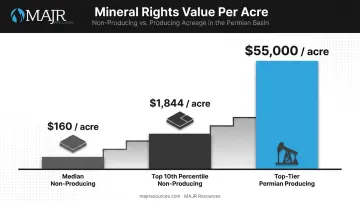
The price swings are significant. A Stout analysis of 87 non-producing mineral transactions between 2013 and 2018 found a median price around $160 per net mineral acre, with the top 10th percentile reaching roughly $1,844. Compare that to core Permian Basin acreage, where top-tier transactions for producing, high-demand properties have exceeded $55,000 per net royalty acre.
That gap, from under $200 to over $55,000 per acre, shows why a single "going rate" doesn't exist. Get a professional appraisal or solicit multiple competing offers before accepting any number. A buyer's first offer is rarely their best one. Independent verification, such as the mineral rights research and due diligence work MAJR Resources provides, helps confirm ownership details and benchmark against comparable regional sales before you finalize a price.
Buying Mineral Rights: A Growing Investment Path
Buyers in this space typically fall into three categories:
- Individual investors seeking passive royalty income
- Energy companies expanding their asset base ahead of drilling
- Family offices or funds looking for long-term, cash-flowing positions
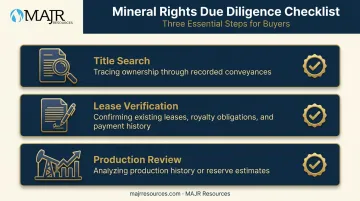
Before any purchase, buyers should insist on:
- A full title search tracing ownership back through recorded conveyances
- Verification of existing leases, royalty obligations, and payment history
- Review of production history or independent reserve estimates
Skipping this step carries real risk. Undisclosed liens, disputed ownership, and previously severed rights don't always surface in a casual records check — especially when a severance was never properly recorded. The Butler case referenced earlier shows how a century-old, ambiguous reservation can resurface and upend what a buyer assumed they owned.
Firms like MAJR Resources handle this verification work daily, tracing chain of title and confirming lease obligations before a deal closes. That diligence separates a secure acquisition from a costly surprise.
Making the Right Choice: Decision Factors and Professional Due Diligence
Key Factors to Weigh Before Deciding
Your decision comes down to a few core trade-offs:
- Financial goals: steady royalty income (leasing) vs. a lump sum today (selling)
- Risk tolerance: comfort with commodity-price swings and drilling uncertainty
- Location and development potential: active basins carry different risk profiles than undeveloped acreage
- Estate planning needs: simplifying fractional interests for heirs
Tax treatment differs across each path too. The IRS taxes royalty income and lease bonuses as ordinary income, typically reported on Schedule E. An outright sale, on the other hand, can generate capital gains treatment depending on how the transaction is structured and how long you've held the interest. Talk to a tax professional before finalizing anything. The difference in tax rate alone can shift which option makes more sense.
Why Professional Due Diligence Matters
Weighing these factors only gets you halfway there. Title errors and weak negotiation are where owners lose the most value. A missed severance, an unresolved lien, or an underpriced bonus offer can cost thousands. Left unresolved, these issues can trigger a legal dispute years down the road, much like the chain-of-title conflicts covered earlier in this guide.
MAJR Resources has worked as a full-service landman partner since 2005, handling title research, ownership verification, and negotiation support for mineral rights transactions of any size across Texas and the broader U.S. Whether you're leasing acreage, buying into a new position, or selling an inherited interest, that verification work happens before contracts get signed, not after problems surface.
Frequently Asked Questions
What's the difference between royalty rights and mineral rights?
Mineral rights include full ownership plus the authority to lease, sell, or develop subsurface resources. Royalty rights only entitle the holder to a percentage of production revenue, with no ownership or decision-making control.
How much are mineral rights worth in Texas?
Value depends on production status, proximity to active drilling, and current commodity prices. Non-producing acreage has ranged from $160 to over $1,800 per acre nationally, while producing acreage in top-tier plays can be worth far more — a professional appraisal is the only way to know your specific value.
Are mineral rights and surface rights separate in Texas?
Texas follows the severed estate doctrine, so mineral rights can be owned separately from the surface land above them. This split ownership is common throughout the Permian Basin, where owners may lease or sell minerals while keeping the surface, or the reverse.
What is Texas's most valuable mineral?
Crude oil and natural gas from the Permian Basin represent Texas's most valuable subsurface resources. The state produced more than 5.6 million barrels of crude oil per day in 2023, making Texas the nation's top oil producer.
What's the difference between leasing and selling mineral rights?
Leasing retains ownership while generating potential royalty income over time. Selling provides an immediate lump-sum payment but permanently transfers all rights, including any future upside.
How can I find out if I own mineral rights on my property?
Start by reviewing your property deed for severance language, then search records at your county recorder's office. For full certainty, engage a professional landman or title service to trace the complete chain of title.