Confusing the two costs landowners real money and leaves energy companies exposed to disputes they didn't see coming. A surface lease covers the ground itself: roads, drill pads, pipelines. A mineral lease covers what's underneath.
This guide breaks down the surface lease definition, walks through how oil and gas leasing actually works, and flags what both sides should know before anyone signs anything.
Key Takeaways
- Surface leases cover land use; mineral leases cover underground rights, legally distinct in Texas.
- Split estates, where surface and mineral ownership differ, are common across Texas oil and gas regions.
- Granting, habendum, royalty, bonus, and Pugh clauses each control a distinct part of the lease deal.
- An experienced landman helps landowners and operators avoid disputes, delays, and lopsided terms.
What Is a Surface Lease?
A surface lease is a legal agreement that grants an operator the right of entry and use of land's surface, meaning the ground itself. That includes roads, drill pads, pipeline corridors, and equipment staging areas. It says nothing about who owns the oil, gas, or minerals sitting below.
A mineral lease works completely differently. It conveys the right to explore for, drill, and produce oil, gas, or other resources beneath the surface. The two documents can exist side by side, cover the same acreage, and still involve completely different parties.
Surface leases aren't unique to energy production, either. The Texas General Land Office issues them for grazing, hunting, timber management, and recreational use on state land. In an oil and gas context, though, the surface lease exists for one purpose: enabling production operations to take place.
The Split Estate: Can You Own Just the Surface Rights?
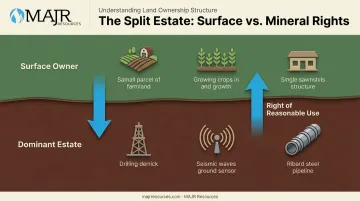
Yes. Land ownership in Texas can be divided into a surface estate and a mineral estate, a setup known as a split estate (also called a severed estate). This happens when a previous owner sold the surface but kept the minerals, or vice versa.
Here's the part that surprises a lot of landowners: in a split estate, the surface owner typically has no authority over oil and gas activity on their own property. That control belongs to whoever holds the mineral rights, or whoever that mineral owner leases to.
Why the Mineral Estate Is Considered "Dominant"
Under Texas law, the mineral estate is the dominant estate. A mineral lessee can use as much of the surface as is reasonably necessary for exploration and production, including:
- Seismic testing
- Drilling operations
- Access road construction
- Pipeline installation
This dominance isn't unlimited, though. Courts have consistently ruled that it applies only "to the extent reasonably necessary." Mineral rights holders are generally liable to surface owners for damage that's excessive or unreasonable, not for routine operational disruption that comes with normal production activity.
How Oil and Gas Leasing Works: The Process Step-by-Step
Energy companies don't just show up randomly. They research geology, ownership records, and production history to identify prospective acreage, then approach mineral rights owners to negotiate leasing terms for exploration and production.
The basic structure is straightforward:
- The lessor (mineral rights owner) grants access and development rights.
- The lessee (energy company) pays a bonus payment upfront, typically per acre.
- Ongoing royalty payments flow to the lessor once production begins, tied to a percentage of revenue.
For a lease to be valid, it needs three things at minimum: an accurate property description, a defined lease term, and clearly stated royalty terms. Skip any one of these, and the lease is vulnerable to legal challenge.
The Primary Term vs. the Secondary Term
Every oil and gas lease runs on two clocks.
The primary term is the initial exploration window, an agreed number of years during which the operator must begin production or lose the lease. According to the State Bar of Texas, primary terms typically run 3 to 5 years.
If no production happens before that window closes, the lease expires and mineral rights revert to the owner.
The secondary term kicks in once actual production starts. It has no fixed end date. As long as oil or gas continues being produced in paying quantities, the lease stays in effect, sometimes for decades.
Why Lease Terms Are Often Favorable to the Energy Company
Here's a practical reality: energy companies draft these leases, not landowners. That means the starting document typically reflects the lessee's interests first.
Regional variation makes this even trickier to navigate blind. A Federal Reserve Bank of Kansas City study analyzing nearly 1.8 million private leases found production-weighted royalty rates ranging from 13.2% in the Marcellus to 21.2% in the Permian Basin.
A landowner using a national "rule of thumb" royalty figure could easily leave money on the table in a high-value basin like the Permian.
Bonus payments showed similar volatility. In the same dataset, bonus figures were only reported for 1.8% of leases, but that sample showed a median of $104 per acre with a 99th percentile reaching $12,000 per acre, a gap wide enough to make generic advice nearly useless.
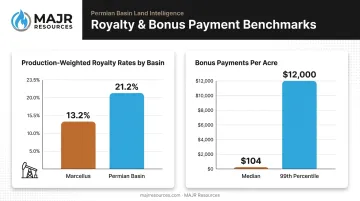
This kind of basin-by-basin and lease-by-lease swing is exactly why MAJR Resources runs mineral rights verification and royalty statement analysis before landowners sign, rather than leaning on rule-of-thumb figures that don't hold up in a high-value basin.
Key Clauses in an Oil and Gas Lease You Should Know
Five clauses do most of the heavy lifting in a standard oil and gas lease. Understanding each one changes how you read (and negotiate) the whole document.
| Clause | What It Controls |
|---|---|
| Granting Clause | Defines the extent of ownership interest transferred and sets obligations for both lessor and lessee |
| Habendum Clause | Establishes primary and secondary term timelines, and what triggers the shift between them |
| Royalty Clause | Sets the ongoing percentage of production revenue paid to the lessor |
| Bonus Clause | Establishes the one-time upfront payment made at signing |
| Surface Use Clause | Specifies where and how the operator may access the surface, and what compensation applies |
| Pugh Clause | Releases non-producing acreage back to the landowner instead of letting the operator hold the entire tract indefinitely |
The Pugh clause deserves special attention. Without it, an operator could produce from a small portion of a large tract and hold the entire lease indefinitely under the secondary term, even acreage nowhere near actual production. A Pugh clause prevents that outcome by:
- Releasing unused acreage back to the landowner once the primary term ends
- Separating shallow and deep rights so unproduced depths aren't held hostage
- Giving mineral owners the chance to re-lease unused portions at current market rates
Royalty and bonus terms are always negotiable. Given how much lease terms vary by region, a fixed 12.5% royalty that made sense a decade ago might be well below what comparable Permian Basin leases command today.
Surface Use, Compensation, and Landowner Protections
Surface use compensation typically takes one of three forms:
- Lump-sum payments for the initial disturbance, roads, and pad construction
- Per-acre or annual payments for ongoing surface occupation
- Damage compensation for crops, fencing, water sources, or other disruption tied to specific operational activity
Reclamation and restoration obligations matter just as much as upfront payment. Once operations conclude, the surface use agreement should require the operator to return disturbed land to productive use, filling pits, releveling pads, and removing equipment and debris.
Texas default law doesn't automatically require this. Compensation generally isn't owed for non-negligent, reasonably necessary surface use, and restoration to original condition isn't guaranteed unless the agreement says so explicitly. Everything favorable to the landowner needs to be written into the contract itself.
Environmental regulation provides a backstop regardless of what the lease says. Texas Railroad Commission rules prohibit surface and subsurface water pollution and impose waste management and pit-closure requirements. If an operator violates these standards, landowners have recourse beyond just the lease agreement, through state regulatory complaints or, in serious cases, litigation.
Why Work with a Professional Landman for Surface and Mineral Leasing
Title research, ownership verification, and lease negotiation require specialized expertise most landowners, and plenty of energy companies, don't have sitting in-house. Tracing a mineral estate's ownership chain back through decades of deeds, wills, and probate records isn't a weekend project.
MAJR Resources has spent over 20 years as a landman and mineral rights partner conducting exactly this kind of work across Texas and the broader U.S. That work includes:
- Researching chain of title through county courthouse records, deeds, and historical transfers
- Identifying every stakeholder with a legal interest, including heirs and fractional owners
- Detecting title defects, liens, and gaps before they derail a transaction
- Verifying mineral ownership status and royalty payment accuracy
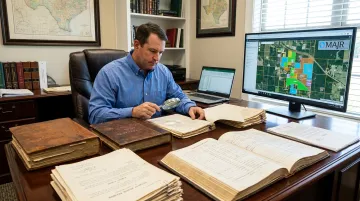
MAJR pairs that historical title research with GIS technology to visualize legal boundaries, map where mineral rights have been severed from surface rights, and identify environmentally sensitive areas before negotiations begin.
Add legal compliance review into the mix, covering state-specific lease requirements, pooling provisions, and environmental clauses. The result is a process built to minimize costly downtime and disputes for landowners and energy companies alike.
Split estate situations especially benefit from this kind of coordinated approach, since ambiguous ownership or overlooked stakeholders are exactly what turn a routine lease into a years-long legal dispute.
Frequently Asked Questions
What is a surface lease?
A surface lease is a legal agreement granting the right to use land's surface for operations like drilling, access roads, and pipelines. It's separate from mineral ownership and doesn't convey any rights to resources underground.
Can you own just the surface rights of land?
Yes, this creates what's called a split estate. In that scenario, the surface owner has no control over subsurface mineral development; that authority belongs to whoever holds the mineral rights or lease.
What are surface rights in Texas?
Surface rights cover use of the land's top layer, but Texas law treats the mineral estate as legally dominant. That means a mineral lessee can use the surface as reasonably necessary for extraction, within limits.
What's the difference between a surface lease and a mineral lease?
A surface lease grants land use and access rights (roads, pads, pipelines). A mineral lease grants the right to explore, drill, and produce oil or gas beneath the surface. They're separate documents covering separate estates.
How much do surface use agreements typically pay landowners?
Compensation varies widely, structured as lump-sum, per-acre, or damage-based payments. The right figure depends on land value, location, and the extent of operational disruption involved.
Do I need a landman or attorney before signing an oil and gas lease?
Professional representation helps verify true ownership, negotiate fair royalty and surface terms, and catch problems before they become disputes. Since these leases can run for years or even decades, resolving ownership questions before signing prevents costly disputes down the road.