Misclassifying one for the other can delay pipeline routing, stall transmission siting, or derail well access negotiations. It can also trigger title disputes or force costly mid-project renegotiation.
This isn't a rare paperwork detail, either. Alabama's DOT alone acquired 238 right-of-way parcels in FY2025, spending nearly $10 million on acquisitions and over $2.5 million on relocation assistance, according to the Alabama Department of Transportation's FY2025 Annual Report. Multiply that activity across every state and every pipeline, transmission, and renewable project nationwide, and you get a sense of how routine — and how consequential — these agreements are.
Key Takeaways
- Right of way is a specific easement for passing or traveling across land.
- Easements form the broader category, covering utilities, drainage, conservation, and access rights.
- Neither transfers ownership — landowners retain title while granting limited use rights.
- Pipelines, transmission lines, and renewable energy sites often require easements, with right of way limited to passage.
- Proper classification and title research prevent disputes, delays, and costly renegotiations.
Right of Way vs Easement: Quick Comparison
The two terms overlap so often that it's easy to assume they mean the same thing. They don't. Here's how they compare across the factors that matter most in energy and infrastructure work.
| Factor | Right of Way | Easement |
|---|---|---|
| Scope of use | Limited to passage or travel across a defined path | Broad — covers utilities, drainage, conservation, pipeline installation, and passage |
| Exclusivity | Typically nonexclusive; often shared among multiple parties | Can be exclusive (single utility) or nonexclusive, depending on the grant |
| Ownership impact | Landowner retains title; grantee gets access rights only | Landowner retains title; holder gets a defined-use right |
| Permanence | Usually appurtenant (transfers with land); may be dissolved by mutual agreement | Appurtenant or "in gross"; generally more legally durable |
| Common energy use | Access roads, pipeline corridors, transmission line paths | Utility installation, pipeline agreements, drainage, conservation restrictions |
A right of way is almost always a specific type of easement, not a separate legal category. The underlying legal interest for both typically derives from easement law.
This is why identifying what's actually been granted in an agreement matters more than the label on the document. The specific rights and restrictions are what count.
What Is an Easement?
An easement is a nonpossessory legal right to use another party's land for a specific purpose, without transferring ownership. In oil, gas, and renewable energy development, easements are the backbone of pipeline routing, transmission siting, and utility infrastructure placement.
Properly secured easements reduce legal uncertainty and protect long-term access for maintenance and operations. The American Petroleum Institute describes a pipeline right of way as property in which both the pipeline company and the landowner hold legal interests. The operator receives a defined corridor, while the owner retains compatible surface uses like farming or grazing.
Easement Classifications That Matter for Energy Work
Not all easements function the same way. The distinctions below directly affect how long an agreement lasts and who can enforce it:
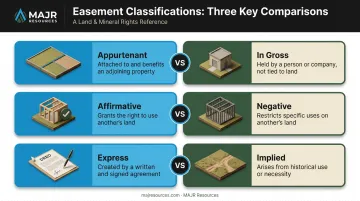
- Appurtenant vs. in gross: Appurtenant easements benefit an adjoining parcel and transfer with it. In-gross easements benefit a person or company rather than another parcel. This is the structure utility and pipeline companies typically use.
- Affirmative vs. negative: Affirmative easements permit specific conduct (building a pipeline). Negative easements restrict conduct by the landowner (blocking construction that would interfere with a sightline or corridor).
- Express vs. implied: Express easements are written into a deed or agreement. Implied easements arise from necessity or long-standing use, a critical wrinkle when historical land records are incomplete or inconsistent.
Duration matters, too. A "permanent" pipeline easement can remain in force for the operating life of the facility, which the Federal Energy Regulatory Commission notes can run 20 to 50 years until the pipeline is formally abandoned.
Use Cases of Easements
Before a single foot of pipe goes in the ground or a transmission tower is set, companies need documented easement rights secured during the land and mineral title research phase. This groundwork forms the legal foundation for everything that follows.
Common applications include:
- Interstate pipelines, where permanent easements cover the operating corridor and temporary easements cover construction workspace
- Electric transmission lines, negotiated directly between developers and landowners before construction begins
- Solar and wind gen-tie lines — the Bureau of Land Management approved a 30-year right-of-way grant for a renewable-generation interconnection line in Arizona, illustrating how long these agreements can run
- Water and drainage infrastructure supporting well pad operations
This is where MAJR Resources' landman team spends significant time, tracing chain of title through deeds, prior leases, and court records to confirm what easement rights already exist before a client negotiates anything new.
What Is a Right of Way?
A right of way is a specific type of easement that grants the legal right to travel across land, typically for a road, pipeline maintenance corridor, or transmission access path. It's narrower in purpose than a general easement, but no less critical to project execution.
Right of way agreements ensure uninterrupted crew and equipment access for construction, inspection, and maintenance. Without one, a routine maintenance visit to a pipeline segment can turn into a legal standoff.
Public vs. Private Right of Way
There's an important distinction between how right of way gets established:
| Type | How It's Established |
|---|---|
| Public right of way | Along highways or through eminent domain proceedings, governed by federal and state transportation regulations |
| Private right of way | Negotiated directly between a landowner and an energy company, with terms and compensation set through private agreement |
Federal transportation regulations define right of way broadly enough to include fee ownership and lesser interests like easements, which is part of why the two terms get conflated so often in casual use.
Use Cases of Right of Way
Right of way negotiation fits squarely into the broader land and mineral title research process. This is where experienced landman services, such as those MAJR Resources provides across the Permian Basin and beyond, identify existing access rights and negotiate new agreements so projects keep moving.
Right of way agreements dominate in:
- Pipeline maintenance corridors requiring recurring crew access
- Electric transmission access roads
- Telecom and fiber infrastructure routes
- Access roads to remote well sites and lease acreage
Washington's DOT reported acquiring 423 parcels for $18.3 million in a single fiscal year through its Local Programs division alone, and that's one state agency, not counting the private pipeline, transmission, and renewable right-of-way agreements negotiated every year across the industry.
Right of Way vs Easement: Which Do You Need?
The determining question is simple: is the need strictly passage, or does it involve a broader land use?
| Factor | Right of Way | General Easement |
|---|---|---|
| Primary need | Access and passage only | Infrastructure installation or an ongoing specific-use right |
| Example uses | Reaching a landlocked well site, maintaining a pipeline corridor, moving crews and equipment | Laying pipe, running power lines, managing drainage |
Here's the nuance that trips people up: right of way is technically a subset of easement. Most energy and infrastructure agreements are legally drafted as easements even when everyone on the project colloquially calls it a "right of way." The label doesn't change the legal analysis. What matters is what the granting document actually authorizes.
Why Misclassification Creates Real Risk
Undefined scope, not the choice of label, is what triggers disputes. Consider Premcor Pipeline Co. v. Wingate: landowners sought to confine two general pipeline easements (serving six-inch and nine-inch lines) to a fixed 30-foot corridor. A trial court agreed and imposed the limit.
An appellate court reversed that ruling, holding that Texas law recognizes valid general easements without a stated width. Courts can't rewrite an unambiguous grant just because it lacks specificity.
The lesson: if predictability matters, the agreement needs to specify width, workspace, access terms, and maintenance rights up front, rather than leaving them for a court to decide later.
This is where combining historical title research with GIS mapping earns its keep. Title research shows what rights exist on paper, while GIS mapping shows where those rights sit on the ground and whether they conflict with a proposed pipeline route or transmission corridor.
MAJR Resources builds both into the same due diligence phase. Clients learn whether an existing easement covers their needs, or whether a new agreement (and which type) is required, before development starts.
Real-World Application: Right of Way and Easements in Energy Projects
Land access disputes rarely make headlines, but they show up constantly in title litigation. The Premcor case above is a useful illustration of what happens when scope isn't defined clearly at the outset.
The core challenge: Premcor held general easements for two pipelines with no stated width. The landowner wanted to limit Premcor's access to a 30-foot corridor, a reasonable-sounding number that had no basis in the original grant.
The resolution: The appellate court sided with the pipeline company. Texas law permits valid easements without fixed dimensions. The scope of use is governed by the original grant plus what's reasonably necessary for the stated purpose, not by what a court thinks sounds fair.
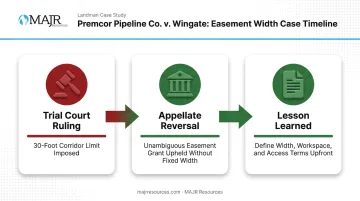
The takeaway for energy companies: This dispute didn't happen because someone called an easement a "right of way" or vice versa. It happened because the original grant left width and scope undefined, leaving both parties to litigate what should have been settled in the drafting stage.
Proactive title research (done before construction, not after a dispute arises) is what prevents this kind of costly back-and-forth. MAJR Resources' landman and title services are built around exactly this: tracing chain of title, identifying existing encumbrances, and drafting agreements with the specificity to hold up in court.
If your project involves pipeline routing, transmission siting, or well access negotiation, getting the classification and scope right before you break ground is far cheaper than fixing it afterward.
Frequently Asked Questions
What is a right-of-way?
A right-of-way is a legal right to travel across another party's property, typically for road, pipeline, or utility access. It's a specific subset of easement law, not a separate legal category.
Who owns property within a right-of-way?
The underlying landowner retains full title to the property. The right-of-way holder only gains legal access rights for the specific defined purpose, such as passage or maintenance access.
What are common examples of right-of-way?
In energy and infrastructure, examples include pipeline maintenance corridors, transmission line access paths, shared driveways to remote well sites, and public roads or sidewalks.
Is a right-of-way the same as an easement in oil and gas or energy projects?
A right-of-way is a specific type of easement focused on passage. Broader easements also cover utility installation, drainage, and pipeline construction rights beyond simple access.
Can a right-of-way or easement be terminated?
Yes. Common methods include mutual agreement, abandonment (demonstrated by clear intent to relinquish the right), expiration of a fixed term, or merger when one owner acquires both properties involved.
Do easement or right-of-way agreements transfer when land is sold or leased?
Appurtenant easements and rights-of-way typically transfer automatically with the land to new owners. Easements in gross are tied to a specific entity and may not transfer without an assignment clause.