The numbers back this up. A 2015 PMI review found that 64% of ongoing oil and gas megaprojects worldwide were facing cost overruns, according to PMI's research on hydrocarbon megaprojects. That's not a rounding error. That's nearly two out of every three major projects bleeding money before completion.
This article breaks down the full project lifecycle, the project manager's role, an often-skipped land and mineral rights phase, and the digital tools reshaping how these projects get delivered.
Key Takeaways
- Oil and gas projects progress through distinct phases, from feasibility to decommissioning, each with its own checkpoints
- Verifying land and mineral rights early prevents costly disputes and project delays later
- Strong project managers blend technical fluency, financial discipline, and stakeholder communication
- Digital scheduling and cost-control platforms have become standard practice across the industry
Why Project Management Is Critical in the Oil and Gas Industry
Oil and gas projects operate at a scale most industries can't imagine. Timelines stretch across years. Budgets run into the billions. Sites often sit in remote or hostile environments — offshore platforms, desert basins, arctic terrain — where a single logistics failure can cascade into months of delay.
Add heavy regulatory oversight covering environmental protection, land use, and safety, and you get a project environment where margin for error is thin.
These challenges aren't unique to oil and gas. According to McKinsey's research on capital megaprojects, which covers more than $1 trillion in capital spending, 98% of large projects exceeded cost estimates by over 30%, and 77% ran at least 40% behind schedule, with average cost increases of 80%.
That benchmark spans industries, but it shows how common these failures are at scale. Oil and gas megaprojects face the same pressures, compounded by remote sites and heavier regulatory demands.
Project managers in this sector face several persistent challenges:
- Schedule and budget control across multi-year timelines with shifting commodity prices
- Real-time information flow between engineering teams, contractors, and executives spread across geographies
- Informed, fast decision-making when field conditions change without warning
- Security and regulatory compliance across jurisdictions with different legal frameworks
Poor project management in this environment doesn't just cost money. It stalls operations, invites legal disputes over contracts or land rights, and erodes investor confidence in ways that follow a company for years. A structured framework from day one is the only way to keep these variables under control.
The Oil and Gas Project Lifecycle: Key Phases Every Project Manager Must Master
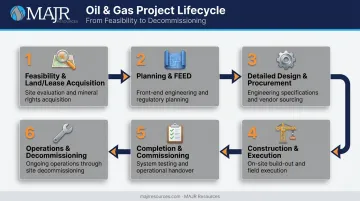
Every oil and gas project moves through a recognizable sequence, even though the specific milestones and terminology vary by asset type and operator. Understanding each phase helps project managers anticipate risks before they become costly delays.
- Feasibility and land/lease acquisition: Teams evaluate site viability and economic potential, then secure land or mineral rights. Ownership disputes and title errors cause the most common early delays, making thorough chain-of-title research essential for firms like MAJR Resources. The American Association of Professional Landmen identifies title research, leasing, and rights negotiation as core due diligence functions here (AAPL's overview of the land profession).
- Planning and Front-End Engineering Design (FEED): This phase translates project objectives into detailed schedules, budgets, and compliance plans, locking down technical scope before major capital commitment.
- Detailed design and procurement: Teams finalize technical specifications, negotiate contracts, and select vendors and suppliers. Decisions made here directly shape execution-phase costs.
- Construction, execution, and monitoring: Drilling, construction, or installation proceeds under continuous safety and quality enforcement. This is typically the longest, most resource-intensive stage.
- Completion, testing, and commissioning: Commissioning connects construction to operations by testing systems, finalizing documentation, and handing off to operational teams. Industry sources describe this phase as the critical bridge where problems either get caught or get inherited by operations (SPE's Journal of Petroleum Technology on commissioning).
- Operations, maintenance, and decommissioning: Once producing, assets require ongoing maintenance and eventual, compliant decommissioning, including abandonment, restoration, and reclamation obligations that regulators track closely.
What Does an Oil and Gas Project Manager Do? Core Responsibilities and Skills
An oil and gas project manager builds and owns the project plan across every lifecycle phase : timelines, budgets, resource allocation, and the trade-offs between all three.
Their core responsibilities break down into four areas:
- Risk management: identifying and mitigating operational, financial, environmental, and political risks before they materialize
- Stakeholder and team leadership: coordinating cross-functional, often multicultural teams while maintaining transparent communication with investors, regulators, and local communities
- Financial and contract oversight: cost estimation, budget forecasting, and contract management to keep the project financially viable
- Trade-off management: balancing cost, schedule, technical solutions, and stakeholder requirements simultaneously — a framework Bain & Company identifies as central to large project delivery
The best project managers aren't just schedulers. They're translators , moving between engineers, financiers, regulators, and landowners, keeping everyone aligned on the same reality.
The 5 C's Framework in Oil and Gas Project Management
A useful mental model for daily decision-making organizes project manager priorities around five practical control areas:
- Cost: tracking spend against budget in real time, not after the fact
- Compliance: meeting regulatory, environmental, and contractual obligations
- Communication: keeping information flowing accurately between field and office
- Coordination: synchronizing contractors, vendors, and internal teams
- Control: maintaining authority over scope changes and schedule shifts
This isn't a formally standardized industry model, but it's a practical way to organize the day-to-day judgment calls project managers make constantly. Miss any one of these five, and the others tend to slip too.
Why Land and Mineral Rights Management Is the Overlooked Cornerstone of Project Success
Before drilling, construction, or FEED can even start, someone has to confirm who actually owns the mineral rights. Skip this step, or rush it, and unresolved disputes can surface months into a project — right when they're most expensive to fix.
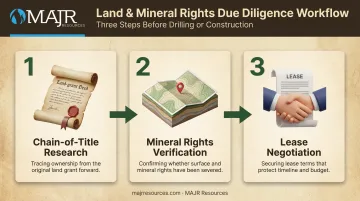
The Due Diligence Process
Verifying ownership isn't a quick records check. It involves:
- Chain-of-title research: tracing ownership back to the original land grant, then forward to the present day
- Mineral rights verification: confirming who holds the rights, especially where surface and mineral rights have been severed
- Lease negotiation — securing terms that protect both timeline and budget
This work matters because poor or delayed due diligence is often "fatal to closing" a transaction, according to the American Association of Professional Landmen's training resources on due diligence timing. Title defects, missing heirs, and competing claims don't resolve themselves. They sit dormant until a deal or a drilling permit forces them into the open.
MAJR Resources, a Monahans, Texas-based landman services firm, builds its verification process around exactly these risk points. Their approach traces a complete chain of title from the current owner back to the original patent.
The firm then checks forward for gaps, fraudulent conveyances, unresolved heirship issues, and severed mineral-surface rights conflicts, all before a client commits capital to leasing or development. GIS technology adds a spatial layer, helping confirm boundaries and ownership across multi-parcel projects common in the Permian Basin.
Beyond Traditional Oil and Gas
This isn't just an oil and gas problem anymore. As companies diversify into solar and infrastructure development, the same land acquisition and rights verification challenges follow them. A solar array or transmission corridor still needs clean title before construction begins.
The actionable takeaway: engage an experienced landman partner during the feasibility phase, not after a dispute surfaces. Early involvement doesn't guarantee a problem-free project, but it dramatically reduces the odds of an expensive mid-project surprise.
Leveraging Technology and Best Practices for Modern Oil and Gas Project Management
Modern project delivery leans heavily on software built for scale and complexity. A few categories dominate the space:
| Platform Type | Example | Core Function |
|---|---|---|
| Scheduling | Oracle Primavera P6 | Planning, resource management, and control across large-scale programs |
| Cost/ERP | SAP Project System | Tracking project costs, revenues, budgets, and resources |
| Cost Controls | EcoSys (Octave Sequence Enterprise) | Structured workflows, funding oversight, and forecasting |
| Collaboration | Oracle Aconex | Centralizing documents, correspondence, and workflow decisions |
McKinsey estimates that comprehensive, efficient use of existing digital technologies could reduce overall capital project costs by as much as 45% (McKinsey's research on digital disruption in capital projects).
That figure spans capital projects broadly, not oil and gas alone, but the underlying logic applies directly: real-time scheduling accuracy, earlier risk visibility, and centralized cost tracking all compound into fewer surprises.
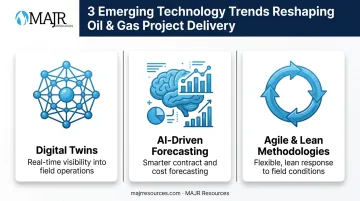
Looking ahead, a few trends are gaining real traction:
- Digital twins: SPE reported in 2024 that this technology is seeing rapid acceptance in oil and gas operations, giving teams a comprehensive operating view for faster decisions
- AI-driven forecasting: increasingly used in contract management and cost forecasting, according to Deloitte's 2026 industry outlook
- Agile and Lean methodologies: borrowed from software and construction, offering more flexibility in how teams respond to changing field conditions
None of these tools replace sound project management fundamentals. They sharpen the visibility a good project manager already needs.
Frequently Asked Questions
What are the 5 C's of oil and gas project management?
The 5 C's (Cost, Compliance, Communication, Coordination, and Control) represent five practical focus areas project managers use to guide daily decisions. It's a working framework rather than a formally standardized industry model.
What does an oil and gas project manager do?
They build and manage project plans across the full lifecycle, covering budgeting, scheduling, risk mitigation, and stakeholder coordination. Their role balances technical, financial, and interpersonal demands simultaneously.
What certifications help you become an oil and gas project manager?
PMI's PMP certification requires 3-5 years of project leadership experience and 35 hours of related education. CAPM offers a common entry point, while an SPE Petroleum Engineering Certification adds technical credibility for engineering roles.
What software is commonly used for oil and gas project management?
Oracle Primavera P6 handles scheduling and resource planning, while SAP Project System manages cost and budget tracking. Oracle Aconex centralizes documents and team collaboration.
Why is land and mineral rights due diligence important for project timelines?
Verified ownership and clean title prevent legal disputes from surfacing mid-project, when they're costliest to resolve. Skipping this step risks stalled permits, contested leases, and delayed drilling starts.
What are the biggest risks oil and gas project managers face?
Price volatility, regulatory and environmental compliance demands, and geopolitical instability top the list. Geopolitical strain in particular has become a growing driver of oil market uncertainty, adding pressure to already tight project margins.