Pooling agreements carry real weight for both sides of the table. Landowners want to know their royalty share is calculated correctly. Operators need a workable unit that meets state spacing rules. Yet many landowners sign leases without fully understanding what a pooling clause allows an operator to do with their minerals.
This article breaks down what pooling agreements are, how they function, the different types you'll encounter, and why experienced landman support protects everyone at the negotiating table.
Key Takeaways
- A pooling agreement combines multiple mineral or leasehold interests into one drilling unit.
- Owners can negotiate voluntary pooling, or a state regulator can order compulsory pooling.
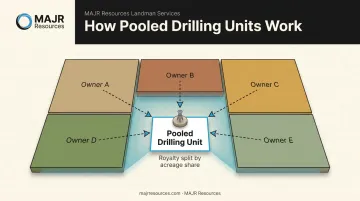
- Royalties in a pooled unit get distributed based on each owner's proportional acreage share.
- Unitization manages an entire reservoir, while pooling manages just one drilling unit.
- Verified title research before signing prevents costly royalty disputes down the road.
What Is a Pooling Agreement in Oil and Gas?
A pooling agreement is the legal mechanism that combines two or more tracts, leases, or mineral interests into a single drilling or spacing unit. Instead of drilling five separate wells on five adjoining tracts, an operator drills one well that produces from the combined acreage. Everyone involved shares in production according to their stake in the unit.
Why does this exist? Reservoirs almost never respect surface boundaries. Without pooling, operators would either need to drill excessive, closely-spaced wells (wasting capital and damaging the reservoir) or leave smaller tracts undeveloped because they can't support a well on their own.
Most leases include a pooling clause: contractual language that gives the operator the right to combine the leased tract with adjoining acreage.
According to Texas A&M Law's review of pooling clauses and statutes, this authority may come from the lease itself or from state statute. In Texas, a lessee has no implied power to pool without an express grant from the lessor.
The Correlative Rights Connection
Pooling also serves a legal doctrine called correlative rights — the principle that every mineral owner in a shared reservoir deserves a fair opportunity to recover their minerals. This holds true even if their individual tract can't support a standalone well. As the Interstate Oil and Gas Compact Commission explains, spacing and pooling rules exist to protect that opportunity while preventing waste from unnecessary drilling.
State regulators enforce this balance. In Texas, that's the Railroad Commission's Oil and Gas Division. In Oklahoma, it's the Corporation Commission. Both oversee pooling to keep development efficient and equitable.
Simple example: Five neighbors sit above one reservoir. None of their individual tracts is large enough to justify a well under state spacing rules. A pooling agreement combines all five into one unit, supporting a single well instead of five inefficient ones, with each owner paid based on their acreage contribution.
How Pooling Agreements Work: Key Components
Pooling agreements aren't one-size-fits-all documents. Several moving parts determine how they function in practice.
Pooling Unit Size and Formation
Unit size depends on geology, not a fixed nationwide standard. Operators determine size based on:
- Reservoir characteristics and drainage patterns
- State-specific well spacing and density rules (Texas Statewide Rules 37 and 38, for example)
- Field-specific regulatory adjustments
- Drilling efficiency and cost considerations
This size directly affects royalty math. A larger unit means your tract represents a smaller percentage of the total, even if production stays the same. For example, a tract in a 640-acre unit instead of a 320-acre unit yields half the royalty percentage, even though total unit production may be identical.
Royalty Distribution and Payment
Royalties in a pooled unit are distributed on a pro-rata basis, calculated using each owner's percentage of mineral interest within the unit. The standard formula looks like this:
Owner royalty = (tract acres ÷ total unit acres) × mineral ownership fraction × lease royalty fraction
Texas's Mineral Interest Pooling Act specifically requires allocation according to each tract's surface acreage relative to the total unit, per the Texas Natural Resources Code Chapter 102.
Before you celebrate that royalty check, review the deductions. Common line items include:
- Gathering and transportation costs
- Compression and processing fees
- Marketing charges
- Severance taxes
These deductions are lease-specific, not automatic. A Texas Supreme Court case, Nettye Engler Energy v. BlueStone Natural Resources, hinged entirely on the specific wording of the royalty clause. Read your lease's deduction language carefully: it determines whether these costs come out of your check.
Duration, Termination, and Dispute Resolution
Pooling agreements generally last as long as production continues on the unit. Production anywhere within the pooled acreage typically satisfies the lease's habendum clause for every tract inside it, even tracts where the well isn't physically located.
A Pugh clause can limit this effect, preventing production from one pooled unit from holding acreage that sits outside that unit. Termination terms should be spelled out clearly in the pooling instrument itself; don't assume a default rule applies.
Beyond duration, pooling agreements define what the operator can and must do once a unit is formed. The operator typically gains the right to:
- Drill and produce from anywhere within the unit
- Allocate costs according to the agreement's terms
- Report production and royalty payments to all owners
In exchange, operators must maintain accurate production records and keep wells in proper operating condition. Well-drafted pooling agreements also specify a dispute resolution process, often starting with negotiation, escalating to mediation, and reserving arbitration or litigation as a last resort. This matters most when royalty discrepancies surface months or years after a division order is issued.
Types of Pooling Agreements: Voluntary vs. Compulsory
Not all pooling happens by mutual agreement. Two distinct paths exist, and the difference matters enormously for owners.
Voluntary pooling happens when owners negotiate and consent, either through a lease's pooling clause or a standalone agreement. This route gives owners more room to negotiate:
- Royalty rate adjustments
- Unit boundaries and sizing
- Specific deduction terms
Compulsory (forced) pooling happens when a state regulator orders non-consenting owners' interests into a unit, typically after an operator has already secured most of the leases in the area.
How Oklahoma's Compulsory Pooling Process Works
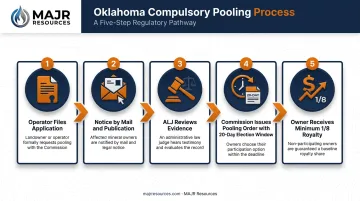
Oklahoma offers a well-documented example. According to the Oklahoma Corporation Commission's pooling order process:
- The operator first attempts to lease or negotiate with owners and files an application naming unleased respondents.
- Notice goes out by mail and publication.
- An Administrative Law Judge reviews evidence on well costs and fair-market-value alternatives.
- The Commission issues a pooling order, and respondents get 20 days to choose participation or a fair-market-value alternative.
- Every unleased owner retains at least a 1/8 royalty, regardless of which option they choose.
Texas takes a similar but distinct approach under its Mineral Interest Pooling Act. Before the Railroad Commission will compel pooling, the operator must first make a fair and reasonable voluntary offer. If approved, an unleased owner is treated as holding a 1/8 royalty interest free of drilling costs, plus a 7/8 working interest subject to cost recovery.
Even under a forced pooling order, non-consenting owners keep their proportional royalty compensation. They lose the ability to veto the unit's formation, but their economic stake remains fully intact.
A Note on "Pooling and Service Agreements"
You may occasionally see the term "pooling and service agreement" used informally. This isn't a standard, formally recognized instrument in oil and gas title work.
The phrase is easily confused with the unrelated financial-sector term "pooling and servicing agreement," which applies to mortgage-backed securities, not mineral rights. If you encounter this wording in a document, read the specific terms closely. The label alone won't tell you what obligations are actually included.
Pooling Agreement vs. Unitization Agreement: What's the Difference?
People often confuse pooling and unitization, but the two tools solve different problems at different scales.
| Factor | Pooling | Unitization |
|---|---|---|
| Scope | Combines tracts for a single well or spacing unit | Consolidates an entire reservoir or field |
| Number of parties | Typically a handful of adjoining owners | Often many leases and multiple operators |
| Primary purpose | Meet spacing rules, avoid unnecessary wells | Coordinate full-field development or enhanced recovery |
| Typical use case | Standard well permitting | Secondary/tertiary recovery, pressure maintenance |
Pooling is the tool you reach for to get one well permitted and producing efficiently. Unitization is the tool for managing an entire field over decades, particularly when injection, waterflood, or other enhanced recovery techniques require coordinated action across every interest in the reservoir.
If you're a mineral owner, you'll encounter pooling far more often than unitization, but knowing the distinction helps you understand exactly what you're being asked to sign. MAJR Resources' landmen verify which agreement actually governs a deal as part of standard acquisition due diligence.
Why Expert Landman Support Matters in Pooling Agreements
Royalty distribution in a pooled unit depends entirely on verified ownership percentages. Get the title wrong, and owners get paid incorrectly, sometimes for years before anyone notices.
Common title issues that cause royalty discrepancies:
- Gaps or ambiguities in the chain of title
- Severed mineral and surface rights that create layered, hard-to-trace ownership
- Undisclosed heirs surfacing after production begins
- Division order errors from incorrect interest calculations
- Ownership changes that never get reflected in updated division orders
Each of these can trigger a payment suspense account — funds withheld while the discrepancy gets sorted out. That's lost time and cash flow for everyone involved.
This is where thorough landman work earns its keep. Before a pooling agreement is finalized, an experienced team typically:
- Runs a mineral ownership report to identify every owner, contact, and percentage of interest
- Conducts chain of title research through deeds, wills, probate records, and prior leases
- Examines county courthouse records to catch liens or unresolved claims
- Drafts curative documents and ratifications to resolve title defects before they delay production
MAJR Resources has spent over 20 years handling exactly this kind of work for oil and gas operators, mineral owners, and investors across Texas and the broader U.S. Our curative completion services, including drafting pooling agreements and resolving title discrepancies, clear the path before ownership disputes can stall a project or distort a royalty check.
If you're an operator assembling a multi-tract unit, or a mineral owner deciding whether pooling makes sense for your acreage, verifying title before you sign prevents the suspense accounts and payment delays outlined above.
Frequently Asked Questions
How does a unitizing agreement differ from a pooling agreement?
Unitization consolidates an entire reservoir or field under one management plan, often for enhanced recovery. Pooling combines smaller tracts into a single well or spacing unit, typically for standard development.
What does pooling mean?
Pooling means combining separate interests into a unified whole. In oil and gas, it specifically means combining mineral or leasehold interests so a well can produce from a shared drilling unit.
What is a pooling and service agreement?
This isn't a standard industry term. It typically describes an agreement that bundles pooling authorization with additional operational or service obligations between the parties — read the specific terms rather than relying on the label.
Is pooling mandatory in oil and gas leases?
No. Pooling only happens if the lease includes a pooling clause granting that authority, or if a state regulator issues a compulsory pooling order after meeting statutory requirements.
How are royalties calculated in a pooled unit?
Royalties are allocated pro-rata: the tract's acreage divided by the total unit acreage, multiplied by the owner's mineral ownership fraction and lease royalty rate.
Can a landowner refuse to be part of a pooling agreement?
Voluntary pooling requires consent. Compulsory pooling laws in many states can override refusal, but the owner still receives royalty compensation based on their proportional share.