But the accessibility comes with confusion. Buyers struggle with unclear minimum investment thresholds, murky cost structures, and tax breaks that get oversold in marketing materials. Ask five different operators about intangible drilling cost deductions and you'll get five different percentages.
This guide breaks down the real ownership structures, actual dollar minimums pulled from SEC filings, the tax incentives that genuinely apply, and the step-by-step buying process, including the due diligence work that determines whether your investment turns a profit or becomes a legal headache.
Key Takeaways
- Ownership options include working interests, royalty interests, lease purchases, and pooled fund structures
- Minimums run $1,000-$10,000 for Regulation A+ offerings and $100,000+ for private placement funds
- First-year Intangible Drilling Cost (IDC) deductions vary by offering, not a fixed promotional percentage
- Mineral rights and title verification are the top risk-mitigation step before closing any deal
What Does It Mean to Buy an Oil Well? Understanding Ownership Types
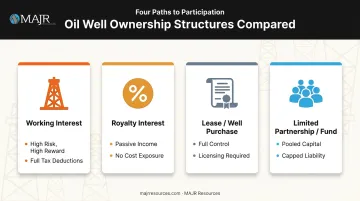
"Buying an oil well" isn't one transaction. It can mean four very different things, each with distinct cost structures, tax treatment, and risk exposure.
Working Interest (Direct Ownership)
A working interest gives you direct ownership in drilling and production operations. You share proportionally in both revenue and operating costs, including exploration, development, and eventual plugging obligations.
This structure carries the highest risk and the highest reward. It also comes with the largest tax advantages, since working interest owners can generally deduct their full share of intangible drilling costs. Hands-on investors and those seeking material tax reduction gravitate toward this path most often.
Royalty Interest (Passive Income)
A royalty interest is a revenue share with zero exposure to operating costs or liabilities. If you own a royalty, you collect a percentage of production revenue without paying a dime toward drilling expenses, equipment, or dry holes.
Federal guidance confirms this distinction: royalty owners generally retain a cost-free share of production, while working interest holders bear the exploration and development burden (Cornell Law, 43 CFR § 3100.5). The tradeoff is fewer tax advantages. No cash calls, but also no depreciation on equipment you never paid for.
Buying an Existing Producing Well or Lease Outright
Some buyers skip fractional interests entirely and acquire an entire producing lease. This route typically means:
- Forming an LLC to hold the asset and limit personal liability
- Hiring an oil and gas attorney to structure the purchase agreement
- Securing state operator licensing before assuming production duties
In Texas, that licensing means the Railroad Commission's P-5 Organization Report and P-4 Certificate of Compliance. The P-4 specifically transfers regulatory responsibility from seller to buyer, and it doesn't take effect until the RRC approves it.
Financial assurance costs scale with well count under current RRC rules:
| Wells Operated | Blanket Financial Assurance |
|---|---|
| 0-10 wells | $25,000 |
| 11-99 wells | $50,000 |
| 100+ wells | $250,000 |
Source: Texas Railroad Commission, Summary of Requirements
Beyond bonding, the initial P-5 filing fee runs $300, with annual renewals reaching up to $1,350 depending on activity level.
Here's the part buyers skip at their own peril: verifying the seller's legal chain of title and mineral rights ownership before signing anything. An unclear title doesn't just risk a paperwork headache.
It exposes you to disputes over ownership, unpaid liens, and liabilities that transfer with the property whether you knew about them or not. Specialized landman and mineral title services, such as MAJR Resources' due diligence work, exist to close this gap before money changes hands.
Limited Partnerships and Oil & Gas Funds
Pooled-capital structures let investors become limited partners under an experienced operator. You get diversification across multiple wells, professional management, and liability capped at your investment amount, though you sacrifice direct control over which wells get drilled.
How Much Does It Cost to Buy an Oil Well? Minimum Investment Requirements
Before comparing minimums, understand the two cost buckets every buyer faces:
- Intangible drilling costs (IDCs) — labor, surveys, drilling fluids. Non-recoverable but often fully deductible.
- Tangible drilling costs — casing, wellheads, tanks. Depreciable equipment with resale value.
Real Minimums by Structure
Actual SEC-filed minimums vary dramatically by offering type:
| Structure | Documented Minimum | Example |
|---|---|---|
| Regulation A+ issuer | $1,000 (then $20 for follow-ons) | Phoenix Energy One |
| Pooled royalty LP | $510 (including transaction fee) | Klondike Royalties II |
| Historical drilling program unit | $5,000 minimum subscription | PDC 2003 program |
| Private placement drilling fund | $100,000 outside-investor minimum | USEDC Drilling Fund 2 LP |
There's no single "typical" minimum for a bilateral working interest purchase. Those deals get privately negotiated well by well.
Accredited Investor Requirements
Most direct working interest and royalty deals get offered under SEC Regulation D, which restricts access to accredited investors. You qualify if you meet the SEC's accredited investor thresholds:
- Net worth over $1 million, excluding your primary residence
- Income over $200,000 individually (or $300,000 jointly) for the past two years, with the same expected this year
Rule 506(c) offerings require all investors to be accredited and verified. Rule 506(b) allows up to 35 non-accredited but sophisticated investors, without general solicitation.
Regulation A+ offerings sidestep this entirely. Tier 2 caps non-accredited investment at 10% of the greater of your annual income or net worth, but doesn't require accreditation status at all.
Budget Beyond the Purchase Price
Qualifying as an investor is only half the equation. The real cost picture extends well past the initial purchase price, and first-time buyers routinely underestimate these ongoing costs:
- Monthly operating expenses (pumper visits, maintenance, utilities)
- State bonding and licensing renewals
- Compliance filings and reporting
- Property and liability insurance
A thorough due diligence review, the kind MAJR Resources performs for energy sector clients, helps surface these line items before you commit capital.
Tax Breaks When You Buy an Oil Well
Tax treatment is often the single biggest driver behind working interest purchases, but the marketing math doesn't always match IRS guidance.
Intangible Drilling Costs (IDCs)
The IRS allows operators to elect deducting eligible intangible drilling and development costs as current business expenses rather than capitalizing them. That's a meaningful year-one deduction. But there's no blanket rule guaranteeing 60-85% deductibility on every dollar invested; the actual figure depends on your specific offering's cost allocation.
Example: Say $60,000 of a $100,000 investment qualifies as IDC, and you're in the 32% tax bracket. That's a $19,200 reduction in your tax bill in year one alone, assuming the deduction offsets ordinary income.
Tangible Cost Depreciation
The equipment portion follows MACRS depreciation schedules. IRS asset class 13.1 (drilling assets) uses a 5-year GDS period, while class 13.2 (production assets) uses 7 years. These aren't interchangeable, so confirm which class applies to your specific equipment.
Depletion Allowances
As reserves get produced, owners can recover capital tax-free through depletion:
- Cost depletion — based on adjusted property basis divided by remaining reserve units
- Percentage depletion — a flat 15% for qualifying independent producers, capped at 100% of taxable income from the property and 65% of overall taxable income
Active vs. Passive Income Treatment
This distinction matters. Under IRS Publication 925's passive activity rules, a working interest held directly—or through an entity that doesn't limit your liability—is not treated as a passive activity, regardless of material participation. That means deductions can offset your W-2 or business income directly.
Once liability becomes limited, as in most LP structures, some income and deductions shift into passive treatment.
Given how much these rules hinge on individual structure, consult a CPA experienced in oil and gas taxation before you finalize how you'll hold the investment. The wrong entity choice can erase benefits you thought you'd secured.
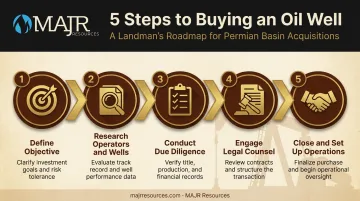
How to Buy an Oil Well: A Step-by-Step Process
Define your objective. Decide whether you want tax reduction, monthly cash flow, portfolio growth, or direct operational control. Confirm your accreditation status if the offering requires it.
Research operators and available wells. Review historical production data and third-party reserve reports. Be skeptical of "future potential" projections that aren't backed by actual well history.
Conduct thorough due diligence. This is where deals succeed or fail. Verify these critical items:
- Deed transfers and clean mineral rights ownership
- Outstanding tax liens against the property
- Royalty and division order compliance records
MAJR Resources' landman team traces chain of title back through deeds, wills, and court records, catching severed mineral rights or undisclosed heirs before you fund the purchase.
Engage legal counsel. Have an attorney review the Private Placement Memorandum, subscription agreement, or purchase contract. Confirm your actual working interest percentage after any reversionary interests kick in, since the headline number in marketing materials isn't always what you net.
Close and set up operations. Fund the investment, then establish your monitoring systems: a pumper for field operations, vendor relationships, and bookkeeping that tracks monthly production and distributions going forward.
Is Buying an Oil Well Profitable? Weighing the Risks
The upside is real: monthly cash flow, portfolio diversification, and a tangible asset that can hedge against inflation. But profitability depends entirely on risks most brochures gloss over.
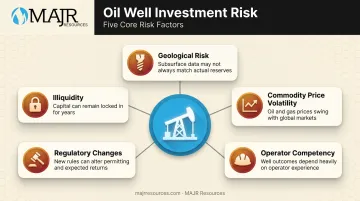
Core risks to weigh:
- Geological risk: dry holes happen, and no reserve report guarantees production
- Commodity price volatility: the SEC specifically warns that promoters can profit even when a well produces nothing of value, while investors absorb the loss
- Operator competency: a poorly managed well underperforms regardless of geology
- Regulatory changes: new environmental or state rules can raise compliance costs mid-investment
- Illiquidity: private oil and gas interests typically have no secondary market and may need to be held indefinitely
Profitability tracks directly with due diligence quality. An accurately verified title separates a well that pays out for a decade from one that turns into a legal and financial drain within the first year. A realistic, document-backed production history matters just as much, and firms like MAJR Resources specialize in verifying both before you commit capital.
Frequently Asked Questions
How much money do you need to buy an oil well?
Minimums range from $1,000-$10,000 for Regulation A+ offerings up to $100,000+ for private working interest placements. The exact figure depends heavily on the structure and operator.
How to start buying oil wells?
Define your goals first, whether that's income, tax benefits, or control. Confirm you meet accredited investor requirements, then research operators and their production history before conducting due diligence.
Is buying oil wells profitable?
Profitability varies widely based on well performance, oil prices, and how thoroughly you vetted the deal beforehand. Weigh the real risks, such as dry holes, price swings, and illiquidity, against realistic return expectations.
What is the minimum investment for a working interest in an oil well?
Working interests typically run $25,000-$100,000, distinct from royalty interests or pooled fund minimums, which can start much lower.
Do you need to be an accredited investor to buy an oil well?
Most direct working interest and royalty deals require accreditation under SEC Regulation D. Some Regulation A+ offerings are open to non-accredited investors, though with different terms and caps.
What is the biggest risk when buying an oil well?
Title and ownership verification top the list, alongside geological and production risk. An unclear title can expose you to disputes and unpaid liabilities long after closing.