Introduction
One overlooked title defect. One overstated reserve estimate. That's often all it takes to turn a promising oil and gas acquisition into a multi-million dollar liability.
Many buyers underestimate how many moving parts sit behind a single purchase price. Land and mineral title, financial records, reservoir engineering, and environmental compliance all carry distinct risks that surface at different points in the process, sometimes long after closing.
The SEC's enforcement action against Miller Energy Resources shows what happens when valuation inputs go unchecked. The company recorded acquired Alaska oil and gas assets at an overstated $480 million, later recognizing a $277 million bargain-purchase gain that materially misstated its financial statements.
This article breaks down a practical, step-by-step due diligence checklist across all four tracks, plus a framework for deciding what to do with what you find before you sign anything.
TL;DR
- Cover four tracks: land/title, financial, technical/reservoir, and environmental/regulatory review
- Assemble a cross-functional team (landmen, engineers, advisors) and secure full VDR access first.
- Lease Operating Statements are frequently unaudited — verify revenue and expenses independently
- Sort findings into clean, minor/curable, or red-flag categories to guide negotiation
- Skipping reservoir engineering review and midstream contract terms are the two costliest shortcuts.
What You Need Before Starting Due Diligence
Effective due diligence starts with assembling the right team, well before anyone opens a data room folder.
You'll need a cross-functional team that typically includes:
- Landmen for title and mineral ownership verification
- Reservoir engineers for production and reserve validation
- Financial advisors to stress-test the numbers
- Legal counsel to review contracts and representations
Once your team is in place, secure full access to the seller's virtual data room (VDR). Most upstream purchase and sale agreements formally define the data room as the seller-established repository covering scheduled properties, contracts, permits, and transaction documents. Confirm nothing has been excluded before you start the clock.
Core document categories to request:
- Corporate and constitutional records
- Title records and lease files
- Financial statements and Lease Operating Statements
- Well and production records
- Permits and regulatory filings
- Existing contracts (JOAs, midstream agreements, marketing contracts)
Before opening a single file, set two things: a due diligence timeline and your materiality thresholds. Decide upfront what issue size would kill the deal versus trigger a price adjustment. Without that framework, teams tend to treat every finding as either trivial or catastrophic, and neither instinct helps you negotiate well.
Core Due Diligence Checklist by Category
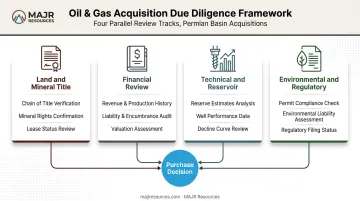
Due diligence on an upstream acquisition runs across four parallel tracks. Each one addresses a different category of risk, and each requires a different kind of specialist to review it properly.
Land and Mineral Title Due Diligence
This track verifies chain of title, mineral ownership, lease status, and whether the net revenue interest (NRI) and working interest (WI) figures the seller is quoting actually hold up.
Checklist items:
- Title opinions and lease abstracts
- Division orders
- Surface use agreements
- Unrecorded interests, liens, or competing claims
Division orders confirm decimal ownership interests but don't amend the underlying lease or operating agreement. NADOA's model form explicitly identifies division orders as confirmations of interest, not instruments that supersede title documents. That distinction matters — a clean division order doesn't guarantee a clean title.
Step-by-step process:
- Pull county/courthouse records covering the tract in question
- Trace the chain of title back to an established root, usually the original government patent
- Confirm NRI/WI figures match seller representations exactly
- Flag encumbrances, easements, or unrecorded conveyances
Title defects remain among the most common deal-breakers in upstream transactions. Because mineral rights are frequently severed from surface rights and fragmented across heirs over generations, tracing ownership requires patient, document-by-document verification.
MAJR Resources' full-title research and mineral rights verification process handles this through county courthouse record pulls, chain-of-title reconstruction, and GIS-based boundary overlays. These overlays cross-reference historical deeds against current geographic reality, confirming ownership accuracy and clearing obstacles before closing.
Financial Due Diligence
This track reviews Lease Operating Statements (LOS), historical revenue and expense data, and pro forma cash flow projections that underpin the offer price.
Checklist items:
- Audited versus unaudited financials
- Cash receipts reconciliation
- Ad valorem tax consistency
- Outstanding liens against revenue interests
Step-by-step process:
- Request the LOS along with any disclaimers the seller has attached to it
- Tie reported revenue back to actual purchaser/payor statements
- Compare historical operating expenses against area norms for similar wells
LOS data is prepared for internal accounting purposes, so treat every number as a starting point rather than a conclusion. Independent verification against actual cash receipts is non-negotiable.
Technical and Reservoir Due Diligence
This is where you find out whether the purchase price actually makes sense. Reservoir engineers validate production estimates, decline curves, and reserve reports that the seller's valuation depends on.
Checklist items:
- Seismic data and well logs
- Production histories
- Decline curve analysis
- PV-10 reserve reports
Step-by-step process:
- Benchmark seller estimates against production data from nearby wells
- Stress-test pricing assumptions used in the reserve report
- Confirm the remaining useful life of wells and surface equipment
The Miller Energy case referenced earlier is the clearest illustration of why this step can't be skipped: an overstated asset valuation went unchallenged and ultimately produced a materially misstated financial picture. Third-party engineering review exists precisely to catch that kind of gap before it becomes your problem.
Environmental, Regulatory, and Contractual Due Diligence
This track assesses environmental liabilities, permit compliance, and existing midstream or marketing agreements that could restrict how you operate the asset after closing.
Checklist items:
- Phase I/II environmental site assessments
- Plugging and abandonment (P&A) liabilities
- Permit transferability
- Midstream minimum volume commitments (MVCs)
Step-by-step process:
- Review available Phase I/II assessments and confirm timing
- Confirm all permits are current and legally transferable to the buyer
- Analyze midstream contracts for acreage dedications and deficiency fee exposure
Timing matters here. Under EPA-recognized standards, All Appropriate Inquiries (AAI) must be completed or updated within one year before acquisition, with certain components refreshed within 180 days. Schedule Phase I work around your expected closing date, not after it.
Unrecorded plugging liabilities and restrictive midstream commitments are two of the most underestimated risks in upstream deals. Midstream agreements can carry acreage dedications, MVCs, and deficiency fees that outlast the current owner. Model these as asset-level burdens rather than routine vendor contracts.
How to Interpret Your Due Diligence Findings
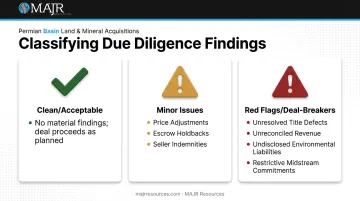
Not every finding requires the same response. Sorting results into three buckets keeps negotiations focused and prevents minor issues from derailing an otherwise solid deal.
Clean/Acceptable. Chain of title is clear, financials reconcile within normal variance, and reserve estimates align with third-party engineering. Proceed with confidence.
Minor Issues. Small curable title gaps, minor expense discrepancies, or non-material permit lapses fall here. These typically get resolved through:
- Price adjustments
- Escrow holdbacks
- Seller indemnities
Red Flags/Deal-Breakers. These warrant renegotiation or walking away entirely:
- Unresolved title defects affecting NRI calculations
- Revenue that doesn't reconcile with LOS figures
- Undisclosed environmental liabilities
- Restrictive midstream commitments discovered late
Many upstream purchase agreements formalize this exact structure contractually. One 2023 SEC-filed purchase and sale agreement required price reductions for qualifying title and environmental defects once their aggregate value exceeded 2% of the unadjusted purchase price, with sellers given a 90-day cure period. That's a useful benchmark for structuring your own materiality thresholds.
With those thresholds in mind, document every finding in a due diligence report and tie each item directly to a specific representation or warranty in the purchase agreement. MAJR Resources builds its due diligence reports around this same three-tier framework, turning vague findings into precise, actionable negotiating leverage.
Common Mistakes and Best Practices in Due Diligence
Common Mistakes to Avoid
- Trusting unaudited LOS data at face value without reconciling it against actual cash receipts
- Skipping third-party reservoir engineering review to save time or fees, which risks overpaying for overstated reserves
- Overlooking midstream and marketing contract terms that can restrict operational flexibility for years after closing
Recognizing these pitfalls is only half the work — knowing what to do instead is what actually protects the deal.
Best Practices for a Smooth Process
- Build your cross-functional due diligence team early, including experienced landmen for title and mineral rights verification
- Tailor the checklist to deal structure — asset acquisitions and corporate/entity acquisitions carry very different risk profiles
- Negotiate a clearly scoped Transition Services Agreement (TSA) if the seller will keep operating the assets temporarily post-close
None of these fixes require exotic tools. They require discipline, and a willingness to verify rather than assume.
Conclusion
Thorough due diligence across land, financial, technical, and regulatory dimensions is what separates a well-priced acquisition from a costly surprise six months after closing. Title and mineral ownership verification remains the area buyers most often shortcut, and it's frequently the one carrying the highest downstream risk.
If you're heading into an acquisition, partnering with experienced landman and due diligence specialists is worth the investment. MAJR Resources has spent over two decades verifying ownership accuracy and clearing title obstacles for energy companies across Texas and beyond, helping acquisitions keep moving toward production without interruption.
Frequently Asked Questions
What does an oil and gas due diligence checklist typically include?
It covers four main tracks: land/title verification, financial review of statements and cash flow, technical/reservoir validation of reserves, and environmental/regulatory compliance review.
How long does oil and gas acquisition due diligence usually take?
Timelines vary by asset complexity and deal size. Title verification alone can range from a few weeks to several months, depending on ownership history.
Who should handle mineral title verification during a due diligence process?
Experienced landmen or title specialists trace chain of title, confirm ownership, and identify encumbrances. This work requires courthouse record access and specialized knowledge of mineral versus surface rights.
What's the difference between due diligence for an asset acquisition versus a corporate acquisition?
Asset deals focus on the specific properties, leases, and contracts being purchased. Corporate/entity deals add scrutiny of employee, pension, and other systemic liabilities tied to the company itself.
What are the biggest red flags found during oil and gas due diligence?
Unresolved title defects, revenue that doesn't reconcile with LOS figures, undisclosed environmental liabilities, and restrictive midstream contract commitments top the list.
Why is the Lease Operating Statement not fully reliable on its own?
The seller prepares LOS data for internal accounting and often disclaims it rather than having it audited. Independent verification against actual cash receipts is essential before relying on it.